Wednesday, 1 January 2020

New in the north: Northern Rail Class 195

Over Christmas 2019 I inadvertently found myself sampling the newest diesel multiple units in the UK, the class 195 with Northern.


Since rail privatisation, and save for a few Siemens (CAF) Class 333s that are now two decades old, Northern and its predecessors (e.g. First North Western, Northern Spirit) have relied on British Rail era trains, either inherited at privatisation or handed down from other operators as they reequipped.  Successive franchises have been let on the basis of no growth and minimal cost. The most notable trains, and apparently hated by customers and very much picked on by politicians were the 'Pacer' units, Class 142 (above) and Class 144, which by 2019 totalled nearly one hundred two- and three-car trains in the fleet.

The current Northern franchise, operated by Arriva since April 2016, promised the replacement of the Pacers as well as increased service levels across the north.  This meant many more trains would be required, so whilst Northern has continued to collect assorted second trains (both electric and diesel, which accounts for the variety of colour seen on trains across the north) it also ordered 101 new trains from CAF.  This order is generally regarded as the 'Pacer replacement' although in reality there is a cascade of stock across the franchise, and former Pacer routes are more likely to be served by Class 150/152/155/156 Sprinters, whilst the new trains serve the Northern Connect network.
 

There are both electric and diesel trains coming from CAF: about two thirds are diesel.  The interior of the diesel version, the Class 195 is illustrated above.  It is an attractive and welcoming interior with a lot of the more popular table seating.  Alas Northern have acquired a lot as two-car trains, which is the last thing it needs when demand is growing.  The UK has enough two-car DMUs before Northern and Abellio acquire any more.  Happy days if you're a CAF share holder!


The seats appear to be the same type of 'ironing board' seats fitted to other recent train deliveries, but come with a bit more padding and arm rests, which makes them reasonably comfortable.

As with many new trains there is the facility to charge your phone on board,  however it is plug only (no USB) and is between the seat bases, so you need to be contortionist to actually use it.   There is also Wifi on board.
The Class 195 also has the facility for seat reservations.  I'm not sure if Northern or its predecessors have used seat reservations since the pre-privatisation days of Regional Railways running the Transpennine Express.


Whilst the proliferation of table seats is a good thing (maybe except for capacity) as usual these days the train designers have not thought people might actually want to look out of windows.  Alas on the scenic routes across the north these trains will operate on, they probably do.  I recall that part if the current Scotrail franchise is to specifically provide facilities for sight seeing, starting with  enhanced window cleaning on trains serving the particularly scenic routes in the highlands.

The 195s also come with automated customer information screens.   There is quite a lot of information on here which takes a moment to calibrate, especially the 'D' in the top right, which is the carriage letter.  On a three car train!  Again this points to Northern introducing seat reservations at some point.

Grab rails on trains and buses need to contrast to the back ground colour (hence bright yellow or green is popular generally contrasting to darker clothing, seats etc).  Not sure about the colour contrast of that grab rail by the door of this Class 195.
Conclusion.....not a bad little train.  Comfortable, quiet.  Few quirks which show the interior was specified/designed by someone who doesn't use trains.  Coming from CAF I'm sure they were cheap, and I hope they give 30+ years service!

Sunday, 22 December 2019

New in Birmingham 2: Buses with catenary

Been to Birmingham Airport recently?  If so you'll have seen two of these large and unmissable monoliths appear.  These are for opportunity charging new electric buses in use on the long stay car park shuttles at the airport.  Opportunity charging means that buses take on a small amount of charge each time they stop at the bus stop outside the airport terminal.

Close up of the charging equipment.

As long as the bus stops at the correct point (which has been painted on the road) the pantograph style charging equipment drops on to the bus to provide a quick burst of energy.   This is different to electric trains where a train-borne pantograph extends to contact fixed electric wires.
Volvo 9700e bus being charged.


And for completeness, from the rear.

The charging infrastructure (the Opp Charge system) includes a screen, presumably intended to be used to incorporate some kind of departure/real time information, and a mysterious red button.

As well as two opportunity charging points, the airport has also installed two plug-in charging points, which when fully charged should give buses 10-12 hours of operation without the need for further charging (however, I expect they will opportunity charge on every trip to keep them out running for longer).

New in Birmingham 1: Trams without catenary

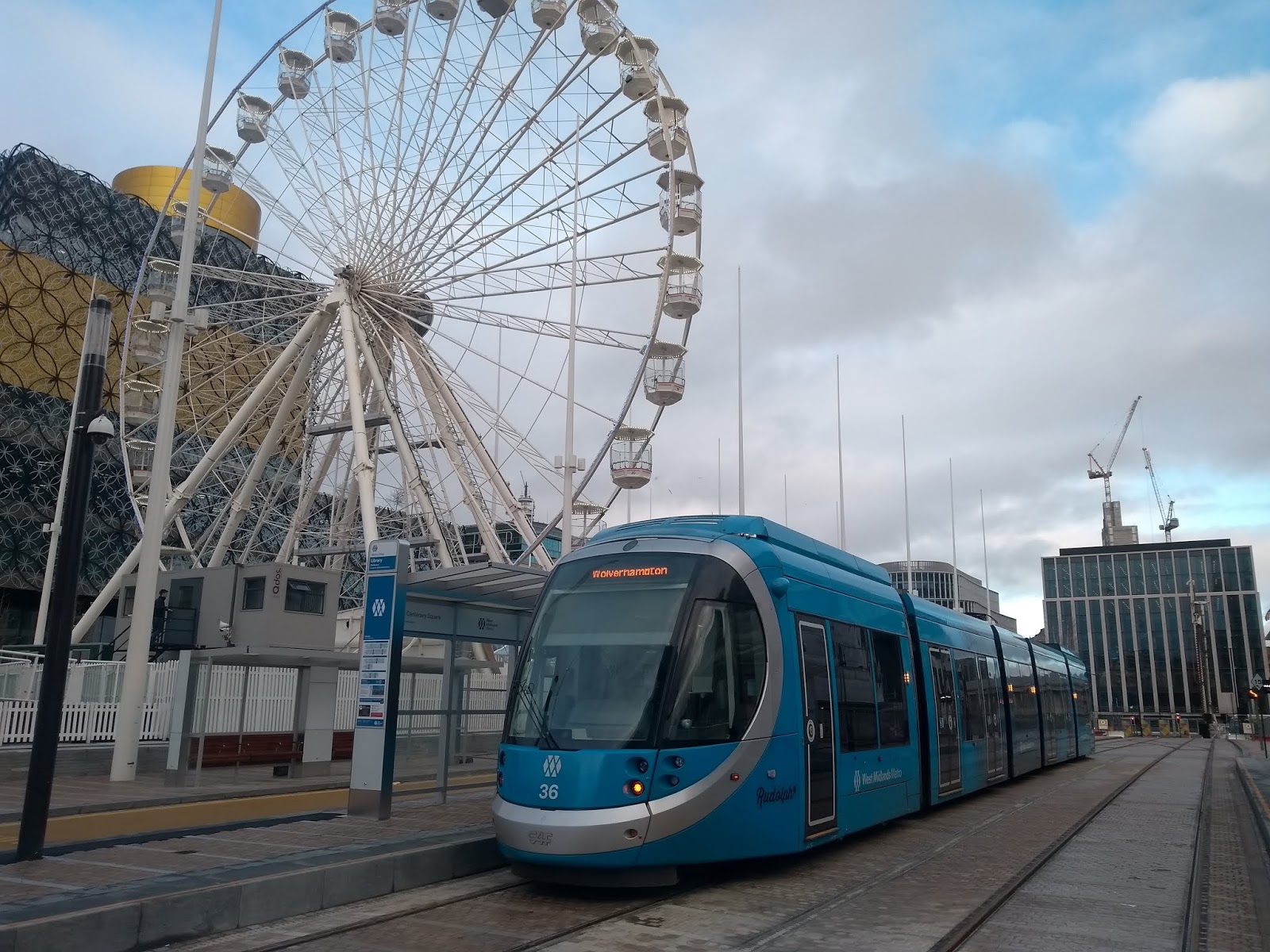
The next phase of Midland Metro has opened.....three years after the extension down Corporation Street, the tram now extends from 'Grand Central'  - for New Street station, to 'Library', better known as Centenary Square.  And it's catenary free!  The CAF Urbos trams have received batteries which allow them to work through the historic Victoria Square  without the need for visually intrusive overhead wires.

A Midland Metro CAF Urbos tram navigates the junction from Hill Street on to Paradise Street. The Frankfurt Christmas Market is in full swing in the background. 

The first of the two new stops is called Town Hall.  I'd have called it Victoria Square.  Despite being delivered with pink branding for Network West Midlands just a few years ago, Transport for [the] West Midlands (as I think Centro is now called) decided on another rebrand of the public transport network, which has resulted in the trams now being blue.  Trains, historically green, have had to be painted gold. Wasteful!  Oh, and Midland Metro isn't a metro....

The second of the new stops, and new temporary terminus, is Library.  I think it would more logically be called Centenary Square, as it is home to a number of attractions as well as the Library, including the International Convention Centre and Repertory Theatre.  The big wheel behind is a temporary addition in the run up to Christmas.

Between Town Hall and Library the Midland Metro negotiates the inner ring road.  It looks like a sea of cones is going to give way to a sea of potentially quite complicated road markings.    On the pus side the bottom of Broad Street, round the Library Metro stop, looks like it is going to be bus only.

The impact of a West Bromwich Albion home game? Trams are supposed to operate every 8 minutes but on Saturday 21 December headways were all over the place. Presumably there's no event timetable to account for this.

Sunday, 15 December 2019

Getting 2.8 million people to Luton Airport every year

Amongst all the noise about the third runway at Heathrow, second runway at Gatwick, possibility of Crossrail 2 or HS3, a long overdue piece of airport/rail infrastructure is quietly taking shape on my doorstep in Luton....

This is Luton Airport Parkway station, opened in 1997.  It is connected to Luton Airport by a shuttle bus, which is initially free but has been charged for the last fifteen years or so, ostensibly to pay for a brand new fleet of Wright FTR buses placed on the service by First.  This has been quietly forgotten as the FTRs were transferred to Swansea, and then a scrap yard, as
older, second hand buses replaced them.
The station opened and shuttle bus operation started when the airport was handling 5 million passengers per annum (mppa).  In 2018 the airport handled over 16 mppa and is expected to meet, if not bust, its maximum permitted of 18mppa in 2019.  Some 15% of those passengers access the airport by rail.  As an airport with a focus on low cost airlines and a heavy [price conscious] visiting friends & relatives (VFR) market, good public transport access is essential.  For completeness, broadly the same number of passengers arrive at the airport by express coach from London. 

The demand for travel to the airport has outgrown the capability to provide it using shuttle buses.  At both ends of the route customers are routinely left behind.   In late 2020 a new rail timetable will be introduced with a half hourly non-stop service between St Pancras and Luton Airport Parkway, which will only increase the number of people choosing rail to access the airport by train. Or at least it would if there was good access onwards to the airport......
Anyone travelling through Luton Airport Parkway over summer/autumn 2019 will have seen a new construction rapidly going up on the east side of the station.  This will be the station for a new automated people mover link between Parkway and the airport terminal.


Whilst to the south the track construction is well under way.
The station under construction, viewed from the west.

And viewing from the north.  The foreground will become an interchange between Luton Airport Parkway and the people mover.

The track towards the airport rises over the A1081 (between the airport and the M1) with a bit of art on the actual bridge itself.

The contractor building the station and new interchange has illustrations on their hoardings showing the works taking place.

There will be a new access to the platforms at Luton Airport Parkway.  This includes lifts and escalators to each platform: escalators were not included in the original station bridge to platform construction, whilst the platform 2/3 lift has been out of service for as long as anyone can remember.
Ain't worked for ages.

Soon to be surplus to requirements.
The automated people mover to be installed is a Doppelmayr Cable Car (DCC)  It's not a monorail!  The DCC was first used at Birmingham Airport to replace its MagLev (admittedly with a bus shuttle for many intervening years).  It has since been rolled out in several airports around the world as well as in Las Vegas where it's known as the Mandalay Bay Tram.   My perception is that the technology is very very simple, which reduces the number of things that can go wrong.  This is essential when 24/7/365 operation is likely to be required (both the Birmingham and Las Vegas applications are effectively 24/7).  

As a cable car it is two trains independently operated, which also means that when maintenance is required, a single train service can be operated.  My only concern was that the trains are specified to be more akin to the Mandalay Bay five-section trains rather than the Birmingham Airport two-section trains, and am pleased to read that they will be four section, capable of operating every four minutes.  The nature of train arrivals does mean that demand will be very 'pulsed' towards the airport but that's a problem every such system faces around the world.

As I say, probably five years overdue at Luton and is a step change in the quality of public transport to the airport.  We don't yet know how it will be charged or if free: like the current shuttle bus my feeling is that it will be integrated in to the National Rail fare structure.  

I wonder if this system will be enough if Luton gets its second terminal and 32mppa......

Tuesday, 26 November 2019

Las Vegas Baby! Trip to Strip

Whilst in Las Vegas in October 2019 I had a need to make some evening journeys for which I expected to be using Uber (as the buses, even the Strip-Downtown Express, are ridiculously slow!).  However I saw a new demand responsive service, Trip to Strip, promoted by the Regional Transportation Commission of Southern Nevada, and being a sucker for demand responsive travel, off I went.....

Strip Downtown Express ('SDX') in one of its faster sections, heading away from the Strip.
Trip to Strip operates in an area broadly covered by down town Las Vegas (the Old Town), the Strip, airport and Premium Outlets South.  To use it you need to down load the app, at which point you discover the software is that of Via Van, and is almost identical in format to Go Sutton, which also used Via Van technology. 
Excellent, service booked and it's eight minutes away. Gives me time to get from the 18th floor of the hotel to the pick up point.

And three minutes later its arrived, I'm being harassed by text message and then by the driver calling me.  (Note the message sent 18 minutes before the clock time!) 
And here is the van.  Rather than pull on to the hotel forecourt, I am directed to the nearest bus stop.  Talking to the driver, I learn that some hotels and casinos allow them on the forecourt and some don't, but mine does, qv.  As can be seen in the app screen print, the app knew exactly where I was, but that wasn't the pick up.....
This service is operated by a Ford Transit van, configured with seats configured in a 'U' shape.  It is also step entry, unlike low floor vans that tend to be used in the UK.  At the front is a cool box of chilled water and bucket for [cash] tips.  At my first destination the driver knows a better drop off location than the one her sat nav advises, but it was handy she pointed out the official drop off as that was the pick up for my next trip. With the same driver.

Much like my other demand responsive experiences, the two drivers I had on Trip to Strip were  unwavingly positive about the service and the customer reaction.  I remember my Chariot driver explaining just how popular the service was, driving around in the PM peak with just me on board.  It seems bus drivers don't have a great grasp of the customer volumes required to break even but do develop positive relationships with their [few] customers!

I think the low ridership/revenue on demand responsive transport is also responsible for the expansion in service area.  Just as Go Sutton expanded their service area, Trip to Strip was also keen to tell me I could go all the way south to M Resort/St Rosa Parkway (a road well known to me en route to the Henderson airport!). 
The target market for Trip to Strip is clearly people who would otherwise use Uber, Lyft or similar service. This is demonstrated by their marketing which highlights 'no surge pricing': at busy times Uber etc will apply surge pricing, which is better known as market forces.  In my case at least, they won!
When I returned to the hotel, on my third Trip to Strip trip of the evening, the driver dropped me off on the hotel forecourt.
My ride back was with another super enthusiastic driver.  The Ford Transit this time had three rows of seats and a wheelchair lift in the rear.  The Americans are generally quite unsubtle about their wheel chair lifts, and this one is no different - a huge lift simply folds out.  The driver was very keen to talk about Trip to Strip, demand responsive buses, Ford Transits or indeed any other subject (maybe hadn't seen a customer for a while) but was also conscious that the app expected him to move off to his nominated parking position.

So another lightly used demand responsive service ticked off.  Uber is a global brand, where customers expect to use the app and get a ride anywhere (ish) in the world.  Locally based DRT requires local knowledge and local apps.  As in so many places DRT seems to be used as an alternative to addressing the real public transport problem: traffic congestion and bus journey times.  I suspect its another questionable use of taxpayers money.  Still, can't fault the positivity of the drivers!

Thursday, 3 October 2019

Belkommunmash in the UK?


This week saw the annual bus and coach trade show at the Birmingham National Exhibition Centre.  One stand really stood out for me, and that was Belkommunmash, one of the world's biggest manufacturers of electric and trolley buses, based in Belarus.  This is the first tine I have seen or heard of them at a western European trade show.

Belkommunmash did briefly gain some notoriety a few years when their trolleybus products were mentioned in the same breath as the now cancelled Leeds trolleybus project.  I think some Leeds concillors visited the Belhommunmash factory but can't find a link to it.

Belkommunmash are trading as BKM Holdings (in their words, "easier to say") and had brought with them a right hand drive version of their E420 electric bus.

The BKM approach to electric buses is on-going charging via pantograph/overhead wire and supercapacitor, gaining around 25km of range from a 6-7 minute charge, rather than the plug-in electric buses more common in the UK, which require longer charging (overnight) for a whole day on the road.  Whilst this requires roadside infrastructure and some accurate parking, the amount of infrastructure required is far less than installing charging equipment for every bus in a bus garage, which in the UK is typically 100-200 buses.  That's a lot of plugs!

BKM Holdings were represented at Coach & Bus 2019 by both their own staff and those of the Belarussian Embassy in London.  The right hand drive E420 will be trialled in Nottingham (not sure which operator) in the near future.

The right hand drive E421.  Modern looks reminiscent of the Wright Streetcar?

The bus is wheel forward.  Whilst buses such as the WF Wright Streetlite and Optare Solo rely on the driver contorting themselves round to serve passengers, in Eastern Europe a bus is more likely to be crew operated and therefore driver/passenger interaction is usually less.

The wheel forward layout means the cab entry and cash tray is behind the driver.  See previous blog post on the Yutong Citymaster for how this is handled with OPO buses in Skopje.  

Interior of mainly 2+1 seating.  For a 12m bus it has very few seats, 27 in total.

Curious emergency exit location, on the floor.

Cab of the BKM E420

A quite amazing central display for the driver,  ADL eat your heart out with all the information here.

The drivers line of sight has quite an intrusive CCTV monitor.  However I'm sure that can be moved.....

In Belkommunmash's home market, this is an earlier body shape of the E443, articulated super capacitor trolley bus operating in Minsk, Belarus,

The charging point in a Minsk bus station.  Knew there'd be a value to this photo one day!  It can be seen that the contact area for the pantograph on the bus is quite small so required precise docking.  However this technology is increasingly been used in countries such as Poland and the Netherlands.  Whilst quite large, this facility takes up much less space than individual charging points for each bus.

BKM's vehicle description

Rear view of the BKM E420
Above all else, the enthusiasm of the BKM Holdings staff stands out!  Their demonstrator vehicle is a right hand drive version of a vehicle built for the eastern Europe market where crew operation and off bus ticketing is common.  Therefore a fundamental redesign of the front axis and cab layout to a more traditional British door forward design is probably necessary for wider acceptance. 

However in the short term I am sure that the UK interest will be around the reliability of the vehicle and supporting infrastructure.  Does the charging set up and charge time/operating time suit British city conditions?  What's the risk of it running out of charge, and how easy is it to recover should that happen?  Is there sufficient charge to finish a rounder then run to and from a depot, or is some depot charging equipment necessary too? 

Overall, is this a viable competitor vehicle and technology to the plug-in electrics supplied by ADL/BYD and Caetano, and how does it stack up against potential competitors from Europe or China (e.g. Yutong, who must be due a UK bus breakthrough soon!).  London wants a fully electric bus fleet: it will need some competition in suppliers.....