Sunday, 19 August 2018

Corfu City Bus

 
In June 2018 I went to Corfu for the weekend (primarily to then fly to Thessaloniki via Athens and back, long story but it made perfect sense).  Not being a fan of taxis I sought to make use of the local bus service for my travels between the airport at Corfu and the town on Kanoni, a couple of miles away.  And sometimes you come across a nice little operation with well presented buses (in no way influenced by their choice of bus) and think 'I want to write about that...'....so here goes!

The hourly bus service between Corfu Airport and Corfu Town gets prominent placing out the front of the airport terminal.  On the other side of the road are taxi and the line up of coaches taking package holiday tourists from airport to their accommodation.

However I didn't initially use the airport bus but walked to the kinda-nearby route 2 for a quicker link to my booked accommodation in Kanoni town. This is the stop.

An assortment of secondhand Mercedes 405s make up the majority of the Corfu City Bus fleet.  Still a fine vehicle!  This short wheel base version (one of four in the fleet according to their website) is approaching the southern terminus of route 2, where it completes the hairpin turn and then reverses on to the stop.

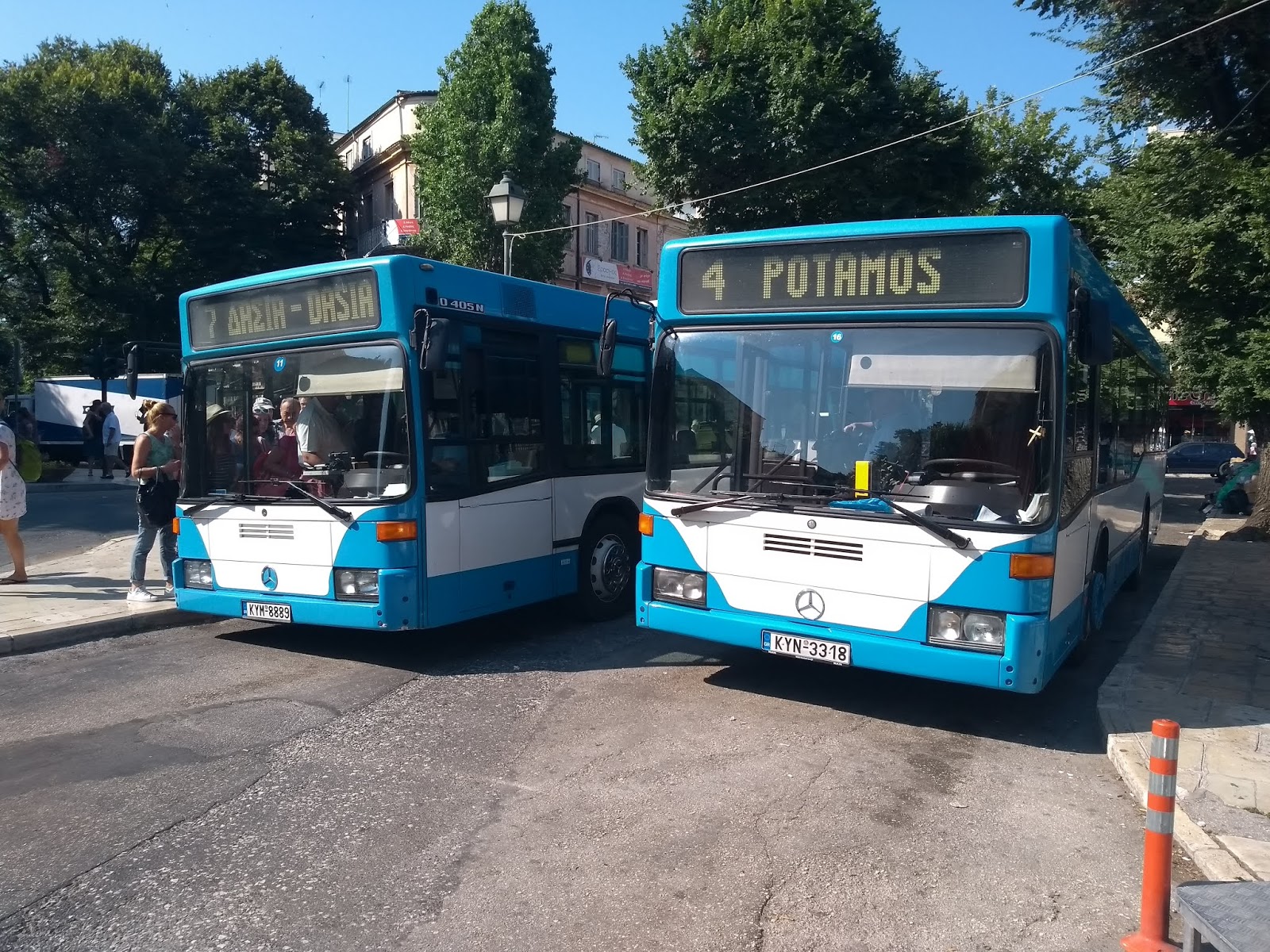
A pair of Mercedes 405s with slightly differing interpretations of the wavy front colourscheme stand in Corfu town.

Vehicle interiors are getting a little scruffy but all the important things like air conditioning work well.

However the second hand nature of the buses is evident, such as emergency instructions in German.  Many buses carried internal fleet numbers and cab signage from their previous operator.

Route maps are displayed inside the buses.  However they are not full route maps: the best interpretation is that they are routes of interest to tourists.

If bus tickets are bought in advance, from a local or shop or the machines at stops in Corfu town, they cost 1.20 Euros.  They are validated for each trip by being dipped in to the driver's ticket machine.  However if they are bought from the driver they are 1.70 Euros.  I received both pre-printed tickets which needed validating, and the more modern receipt type ticket from drivers.

Day tickets for Corfu City Bus are also available. They allow for a discount on the open top tours of the Corfu town area; I assume the open top service and Corfu City Bus are related operators.

If you take up the option of the open top bus tour there are two Dennis Tridents in use with the Corfu City Tour, which according to the Open Top Bus Site were formerly in use in San Sebastian, Spain.

There are also three of these IndCar contraptions for open top tours.

Timetable information is generally very simply presented and easy to follow.  It is not hot on intermediate timing points though.  Corfu town square the effectively the blue bus station, and longer distance coaches round the island of Corfu run from the green bus station, a little way out of town.

The bin men were revolting!  And accordingto on-line forums their strike is either an annual or permanent feature of life on Corfu.  There were piles of rubbish everywhere.

Gratuitous Merc 405 shot in Corfu town.

One at the Kanoni terminus.

And a 12m version outside Corfu airport with the white wheel trims looking very smart,

And finally why Kanoni.  For the top floor of Anna Apartments overlooking the threshold of Corfu's runway!

Great photos!

Wednesday, 8 August 2018

Dortmund Airport bus service

Another rip off airport service!  There is a shuttle bus between Dortmund Airport and the nearest station at Holzwickede.  At the airport there is a ticket machine for the local transport, so on my last visit I bought my day ticket, and boarded the bus to the station. The bus being exactly the same type and livery to other local buses, and to all intents and purposes it was a local bus.  German bus drivers don't often do much in the way of ticket checking.  Cue shouting from the driver. Turns out that the five minute journey to the station commands an additional fee of 3 euros.

The stop at Holzwickede station.

Hidden down the bottom of this notice (presented in the standard style for the area) in the small print is the news of a 3 euro fare, reduced to 2 euros for children.

And whilst we're here, for the few who still believe German railways are better than the UK, the station real time information isn't much cop...

And for completeness this is the Stadler FLIRT I travelled on.

Danglebahns: Dortmund, Dusseldorf und Wuppertal


The Wuppertal Schwebebahn is one of the most famous 'tourist attractions' for transport enthusiasts, operating over an eight mile route in the middle of the Ruhrgebeit conurbation of Germany.  However the area is also home to two similar, modern systems built by Siemens known as H-Bahn, literally Hangebahn, the hanging train.

Dortmund University H-Bahn is a two-line system, opened in three phases a decade apart between 1984 and 2003.

Most of the Universitat Dortmund Hangebahn is at height.

The final extension in 2003 was to Technologiezentrum.  Car 3 is one of five Siemens trains used in the H-Bahn.
 
However the section towards the southern terminus at Eichlinghofen is barely above surface level, which is a really weird sensation to travel on.

The track is well protected by fencing as well as platform edge doors.  There are also stablisers for the train and extendable gap fillers between platform and train.

Station interiors are very 1980s and spartan. However for most of the day the service operates on five minute headways.

Train interiors are also simple, however the typical journey is just a couple of minutes.

Ticketing is integrated within the local Dortmund 'DSW21' and regional 'Verkhersverbund RheinRuhr' systems.

At Dusseldorf Airport there is an H-Bahn operating between the airport terminal and the long distance railway station via two multi-storey car parks.  The basic technology is the same Siemens system as Dortmund University, with body styling having moved on.

And the grand daddy of them all....the Wuppertal Scwhebebahn, the suspension railway.  serving 21 stations along the alignment of the Wupper River, between the towns of Vohwinkel and Oberbarmen.  Again it is an integral, and integrated, part of the local transport system.

One of the 1972 'GTW72' trains passes along the Wupper.

There is public access to the turning circle at Oberbarmen :-)

Train loading

Unlike Dortmund University and Dusseldorf Airport, there are no platform edge doors,  Customers could wander on to the 'track'.

From my archives, a 1972 train back in 2004.

The fleet is being replaced by 'GTW15' trains built by Vossloh.  The naming convention is delightfully simple like London's Tubes.

The interior of GTW72 and GTW15 trains is similar.  This GTW15 is a cracking attempt at a retro interior!

A local brewery has a model schwebebahn running around the ceiling!
And whilst we're in the area, here's a few more transport highlights....
The original P86 and P89 trains from the Docklands Light Railway are now used by EVAG, the municipal operator in Essen.

One of the original kerb guided busways is also in Essen.  This photo dates from a 2004 visit, and anyone subject to bus rapid transit propaganda in the UK will have seen this photo before!

In Oberhausen there is a shared bus and tram way.  Here's a bus....

....here's a tram....

....and here's a bus and a tram!

The local railway scene is as colourful as the UK, with many multi-national operators represented.....such as National Express here....

....Veolia operate under the NordWestBahn brand....

....Keolis Eurobahn....

....and Abellio.

Friday, 27 April 2018

Arriva the Shires trying it on

There are several bus routes which operate between Luton and Luton Airport, including three by the dominant local operator Arriva.  The two principal services are the 'A', which is one of the routes which uses the guided busway to Dunstable, and the 757 which is a Greenline branded coach service that continues past the airport to central London. 

There is a heavy demand for travel between Luton town centre/station interchange and Luton Airport, fuelled by passenger number growth (the airport handles around 16 million passengers per annum with aspiration for millions more) and the jobs that are generated as a result.  A couple of years ago the 'A' service was extended to operate overnight half hourly.

Where multiple routes operate over a common busy core section it offers the customer a better service and shorter wait times: reliability and shorter journeys is just the way to maintain and grow patronage.

Arriva's 'A' route from Dunstable to Luton Airport uses dedicated busway for much of its journey including guided busway.


Historically I have used the A and 757 interchangeably, where the same fares were available.  However a few weeks ago the first service available was a 757 (it was just after 2am!) and I learned that Arriva the Shires have decided to charge different fares for exactly the same journey.  The single fare between the airport and town centre on the A is £2.30, whilst I was charged £3 on the 757.  This revelation came after I started apologising to the driver for not having £2.30 in anything like correct or near-correct change.


Same journey, same operator, 30% fare difference.
My first instinct was that the driver was trying it on and would pocket the difference but a ticket was issued, and anyway the route 757 drivers are probably the 'top link' drivers (I've decided to let the three minute early departure go!).

So I asked Arriva why they charge different fares for the same service, using Facebook Messenger.

Really?


So there you have it.  The Arriva Shires fares model is directly based on the operating costs of the service.  I could have asked if customers got a discount every time a service bus operated a coach service (like the lucky people of Hemel often get), or if my fare on a local route should be different if a seventeen year old Trident turns up rather than a brand new Wright Streetlite.  Also, the 757 service I caught only had me as a passenger: should I bear the full cost of operation or should Arriva be glad to get some revenue from it?

I like Arriva the Shires in the main.  I like the busway (and am a little surprised at how successful it has been).  I like the fact Arriva have taken a risk with the all night service, seven days a week to the airport.  Even at £2.30 for an eight minute journey after watching airport staff buying £1.50 returns, I still quite like the service.  But as you might guess I think Arriva's fares policy is utterly nuts.  Any other examples of same operator, same origin, same destination, radically different fares?