Tuesday, 9 May 2017

Breadvans back in vogue: Citymapper starts a bus service


For two days only some green minibuses are appearing on the streets of central London......Citymapper, the website and app preferred by many a Londoner for their directional and travel needs, is running a free bus service numbered CMX1 between the Waterloo and Blackfriars bridges.  It operates on Tuesday 9 and Wednesday 10 May 2017 and is free.

A one way loop is operated.

Vehicle of choice is the Mercedes Sprinter.
So, needing to travel from Southwark to Victoria at lunchtime I decided to take the free Citymapper bus.  The buses (three of them) were visible on the Citymapper website, but despite a lot of hype about better routing and responding to consumer demand, there was no 'on demand' element: rather I went to one of the conventional TfL bus stops the special service was running from.

The bus arrives.  First thing I did was to work out the legalities of operation.  Thankfully an O-disc and legals were carried for Impact Group, who are a large operator of corporate/school contract services in west London.  I don't know much more about Impact but that seems a good place to start.  The chap nearest the camera stood in the bus stop was wearing an Impact jacket: instantly knew what I was doing, being a stones throw from Transport for London offices etc.....BT66UAS is fleet number CMS02.

Inside it looks like a minibus with a large screen displaying the route.....

....next stop, expected journey time, and some marketing gumph.

This Sprinter has standard bus seats, in corporate Citymapper green, and were equipped with USB charging points.  This seemed to garner a lot of favour with passengers, although these are available on pretty much any new bus should the operator specify them.  A number of passengers asked about wifi, and were surprised Citymapper didn't have it. This actually says a lot about expectations of a tech company.  And again wifi is available on any bus if the operator asks for it. 
 
Citymapper employees were gathering user feedback.  There was more feedback about the Citymapper app rather than buses in particular,  The Citymapper employee (in green if course) was a lawyer by trade.


I left the bus initially at stop R at Somerset House, shown above.  When I later tried to continue my journey it turns out the service doesn't actually stop there.  Important lesson for Citymapper: make sure drivers know the stops.  After making my way to the correct stop I was admonished by the driver for not signalling clearly enough I wanted the bus - yet my previous driver had stopped at every stop and opened the doors irrespective.  Further there is still a long way to go in getting a consistent customer service ethic amongst bus drivers.

A short piece to camera.  Not sure who this is but sure it will appear on the Londonist or somesuch tonight!
Citymapper have generated an amazing amount of publicity for themselves with this exercise.  It features on many London and tech blogs as well as mainstream press such as the Evening Standard, the Telegraph, Time Out, and City AM. 


The driver is the hero!  When he's not instructing me on how to hail a bus that is!

On my return from Somerset House to Southwark our bus was regulated on Westminster Bridge.  Seems Citymapper have probably learnt it's not that easy to run a reliable bus service despite choosing a nice simple loop!

And then everything that's bad about conventional bus regulation gets repeated!

Because at the end of the day any attempt to 'reinvent' the bus is still running on the same roads as every other bus!
The route CMX1, a 'pop up' bus route is not a bus route that anyone will ever operate: everywhere it goes is walkable, and there are plenty of conventional buses for the busy bits.  They are talking about technology: the driver is equipped with an Ipad in lieu of a ticket machine, and they talk about regulating headway by speeding up or slowing down.  I think this is a red herring: in London you either drive or you don't!  This project apparently has Transport for London's blessing so it [probably] isn't about starting new bus routes. 


It probably isn't about demand responsive bus routes either - the smaller vehicle may be more nimble but not that much more nimble.  I think an attempt at demand-responsive buses in London would get to a point where it becomes more efficient to operate larger vehicles to a fixed route on a high frequency - i.e. the London bus network!

Some of the marketing and reporting linked above talks about reinventing the bus.  This sort of talk will probably grab the attention of millenials, and a good proportion of older frustrated bus users too.  But what is 'reinventing the bus'?  If we can't go any quicker, and we can't go any cheaper (London bus fares are the lowest in the country) what do we mean by reinvent?  A bus is a bus is a bus.  Occasionally new ones appear with a shiney coat of red paint and a new style of headlight cluster, but before long it's a grubby red bus and that new body style is common.

Citymapper must have quickly learnt that any attempt to change those things which annoy passengers needs more than an internal flat screen and funky green paint.  Traffic, congestion, and bunching affected Citymapper as much as it affects any one of the other 8,000 buses on the road in London.  On one trip our American lawyer host told us we were waiting because of a phenomenon called 'bus bunching'.  When a young girl from a tech start up tells you this is strangely more acceptable than a middle aged male driving a red double decker!  The upshot of this is 'reinventing the bus' is getting back to basics: the bus turns up when the timetable, website, journey planner, app, etc, tells you it will, and the journey time is whatever that medium has told you it will be.  Next stage is to reduce journey time, making buses - and public transport as a concept - more attractive.  That takes a lot of political will to deliver!

So, what are Citymapper up to?  Well, whatever it is they have invested in three brand new buses for it. I think they are on a data collection exercise.  I think they have an open ended project (with a few hundred K budget) to go and generate data on whatever they feel would help them evolve.  And that is understanding the constituent parts of a bus journey in more detail than they do now.  What affects journey speeds - traffic, signals, road design, driver behaviour, customer behaviour.

Or, maybe they do want to be the new urban transit option.  Tech companies that do transit (Uber, etc) are increasingly part of the mainstream transport network, working with and sharing data with local authorities rather than working against them.  May, just maybe, Citymapper wants a bit of that?

More main stream bus operators are also trying to reinvent the bus, or at least the minibus.


Another demand responsive operation with 66-plate Sprinters is Stagecoach Little & Often, which started this year in Ashford, Kent.

Arriva are trialling demand responsive buses in Sittingbourne, branded Arriva Click.  These Mercedes Sprinters are notable for their single leaf entry and rear tail lift for mobility impaired customers.  They also have a gorgeous leather interior!

Demand responsive minibuses gather en-masse at Chisinau bus station!
Any opinions expressed are mine and mine only and NOT those of any of the excellent organisations I work for!

Sunday, 18 December 2016

The Yutong City Master, a fake Routemaster?


So when I had the opportunity to book one more flight with my Wizz Air Club membership, Skopje it was!

In 2011 and 2012 the municipal operator in Skopje, JSP, took delivery of over 200 Yutong City Master buses.  They buses appear to be a Routemaster 'influenced' body on standard Yutong ZK6116HGS double decker.  The double deckers, with a more conventional layout, remain available from Yutong, which is one of China's largest bus manufacturers.  I am not aware of any other city adopting the City Master body, although internet sources suggest there are some in Guangzhou, in southern China,

The  City Masters were delivered with a white band around the whole body, making them very reminiscent of a 1970s National Bus Company livery.  However most have had the band on the body sides and rear stickered/painted over - the reason certainly isn't obvious!
 
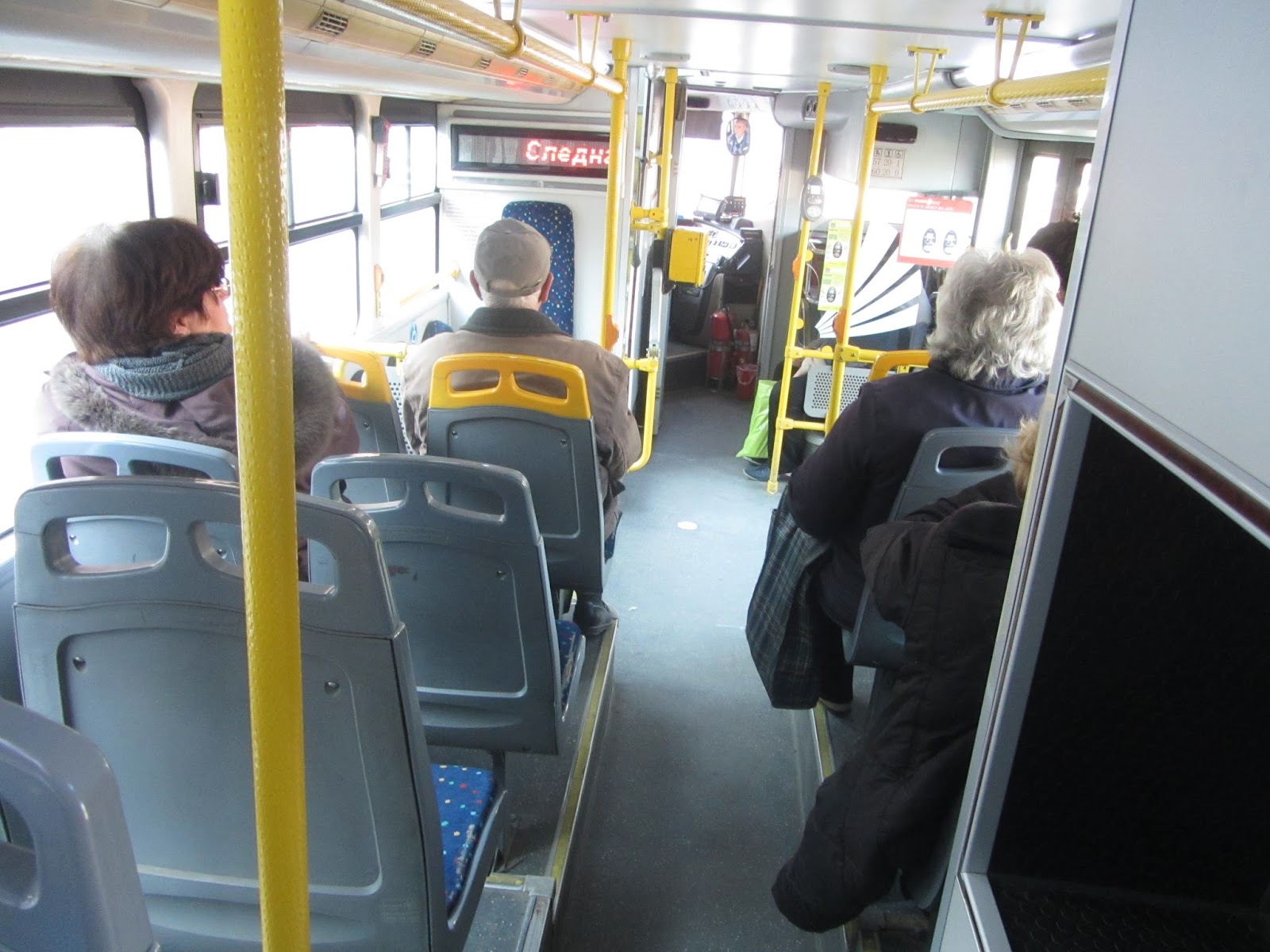
The majority of the City Masters have a red electronic destination display, which is fairly unusual.  They do generally work, albeit showing routes and via points in Cyrillic.  The poor quality shown here is a factor of the camera/photographer not the bus!

However the higher numbered City Masters have a more conventional orange display.  A common feature also seemed to be non-illuminated off-side head lights.  It seemed too common to be a failure so may be a 'day light running' feature with the near side only illuminated.


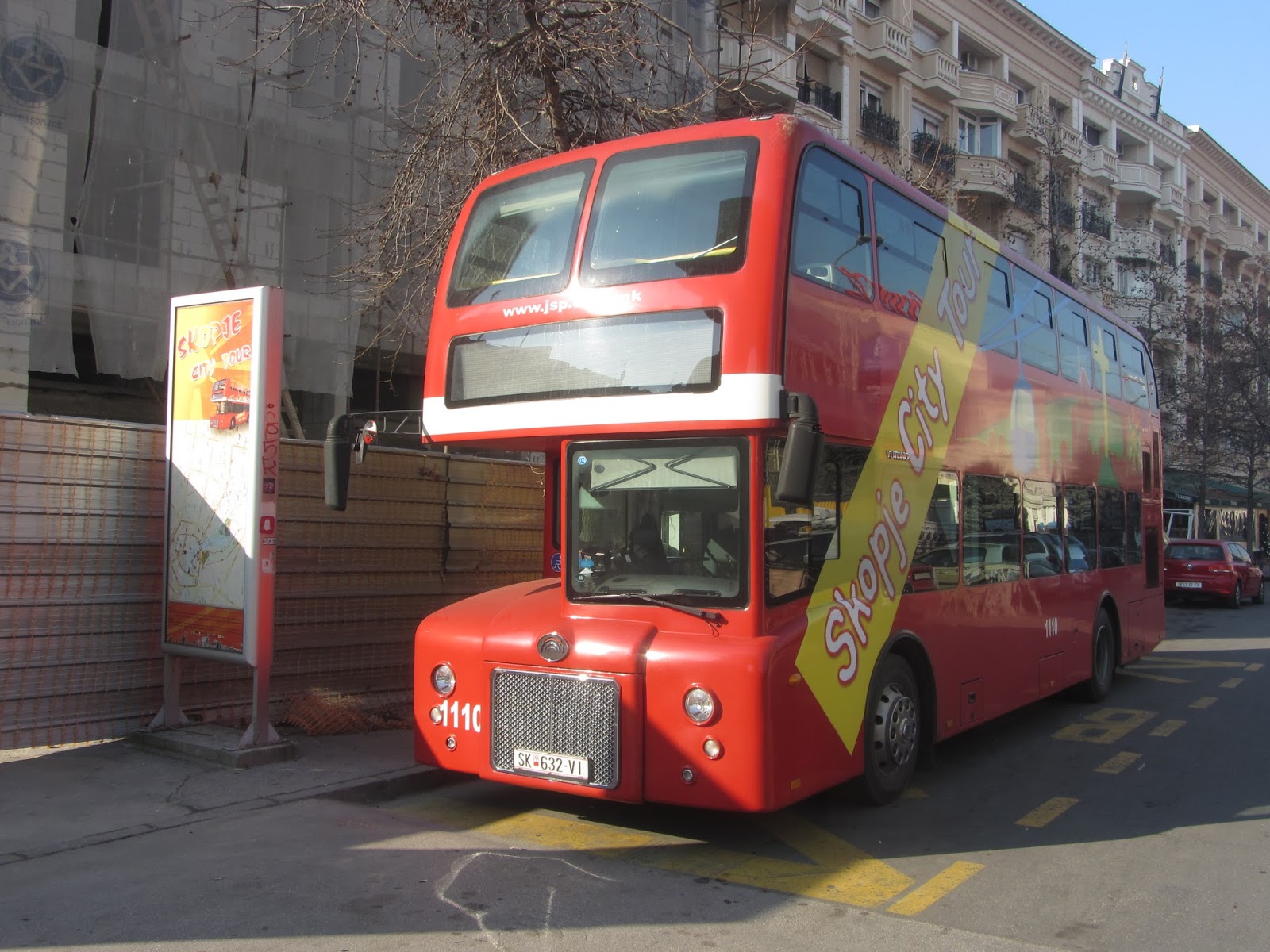
Apparently 15 City Masters are fitted with removable roofs for tourist operations.  This feature was not required in my December visit!  One City Master with 'Skopje City Tour' branding (looking like a slight rip off of City Sightseeing) was parked up for much of the day in the city centre but I didn't see any bearing this livery in operation.

The unusual nose appears to present more visibility problems than ye old AEC Routemaster, with the solution being this three mirror set up on the near side mirror arm.  Say hello to me!

Whilst there is a Routemaster style cab, it is accessed from the main saloon.  Tickets can be bought off vehicle in newsagent kiosks for 30 Macedonian denars, or from the driver for 35 denars.  To facilitate purchase there is a cash tray in the cab door, which is rather inconvenient to use as it is effectively behind the driver, and the vast majority do tickets whilst they drive!  It isn't even like, say an Optare Solo, where passengers pass you on boarding: passengers may board through the centre or rear door.  The consequence of this most drivers seemed to drive with the door fully open to ease the purchase of tickets.

This is an overview of the rear saloon.  The City Master has two staircases, one on the off side behind the driver, and one to the near side at the rear.  In this photo there is luggage space under the stairs - though I never saw it used.

The upstairs of the City Master is fairly conventional in layout: there is a single bay of 4 behind for the forward stairs, and the seats are Chinese built and hard, I like to think based on the dreadful Esteban Urban 90!

The rear stairs are forward of the rear door - and the engine.  Yes, despite the Routemaster inspired design at the front, the engine remains in a vertical cabinet on the off side at the rear!  This means there is space behind the rear stairs for seats: two forward facing and one sideways facing Rowley Seat are provided as well as 5 across the back.  Like any city bus they have their fair share of grafitti,
Tight circular stairs which were relatively easy to use on a moving vehicle.

The upstairs has two roof level emergency escape routes.

The front windows are provided with window blinds, beautifully self-branded by Yutong.  The mechanism to use this one is sort of defective but enough random pulling ensured the blind eventually went up again.  I always think the Chinese manufacturers are brave to give this kind of feature to drivers let alone passengers.

Sliding opening windows are provided.  Stickers on the windows about smoking etc are faded - they are here just difficult to see.  Most emergency hammers were missing, as seen here.

There are six clips securing the access to the destination display.  On the vehicle I rode on at the front, 4 of the 6 could not lock because the lower part of the mechanism was completely missing.  Nice things for customers to catch their shins on.

The interior ahead of the forward stairs is fantastically well provided for with air vents!  Buy one get ten free!

However the air vents found in most of the bus are falling to bits.....

....or have fallen out completely.....

.....or have been covered with some gauze a local fitter has found.

And now a few more images of City Masters going about their trade.


So what did I make of it?  The design is just too quirky - it really is only about image and having something unique, and if that's what Skopje and Yutong set out to do they have succeeded.  The ticketing is weird, it will work with 100% off bus ticketing (so may be London!?) but places a great stress on the driver, and I expect moving the engine to the logical place was going to be just too expensive.  Speaking of the engine, it is smooth in motion, seems to clim what hills it can find effortlessly, and has quick gear changes, but when stationary it rattles and vibrates like....a rattling and vibrating machine.  It's otherwise a comfortable enough city bus and no worse than designs in western Europe.  I believe that Yutong are probably the most 'with it' of the Chinese bus manufacturers and will eventually crack it in the west. Would love to compare it to their conventionally laid out double decker.


Tuesday, 13 December 2016

Pristina to Skopje by Train

This year has been one of finally visiting some of the former states of Yugoslavia.  Having been to Slovenia, Croatia and Serbia in the year, this time it was the turn of Kosovo and Macedonia (also known as FYROM, the Former Yugoslav republic of Macedonia, to avoid confusion with the northern Greek state of the same name).  As with a lot of this part of the world, privately run coaches offer the principal means of inter-city transportation, with state run railway enterprises offering infrequent and slow services, not so much in competition but in a nod to the past, and presumably in the hope that one day the investment will be there to offer a much better service.  Two such operations are Kosovo Railways ('Railkos') and Macedonian Railways ('MZ').

One of the purposes of this blog is to update the experience on the fantastic Seat61.com website. Wikipedia provides a surprisingly detailed overview, though I suspect a little out of date, of the operations of Kosovo Railways.

Railkos is not a busy operation, providing a total of ten passenger trains per day, consisting of two round trips between Pristina and Peje, one round trip between Pristina and Skopje, and two round trips between Pristina-Kosove and Hani i Elezit.  Kosove station is located in the west of the city and appears to be the home of Kosovo Railways, with multiple sidings located along its north side and further to the west.


This is my experience with Railkos and MZ......

I did a recce to Pristina station the night before travel, and was lucky enough to see the afternoon's service to Peje depart, with former Yugoslav Class 661 heading five coaches and a generator/cargo van.

Passenger milling around the unlit Pristina station, usually smoking, until a loud whistle from the loco determined it was time to go!

This is Pristina station frontage; to the left behind the black tarpaulin is a night club of some sort, playing dance music well past 7am.

The right hand window is the information and ticket window of Railkos at Pristina.  Upon inquiring about the 07:10 train to Skopje the ticket office chap told me it went at 07:30.  He seemed slightly bemused I wished to buy a ticket, which was 2.50 Euros.  Exactly the same ticket from exactly the same ticket issuing machines could be bought on the train.

The Trainkos ticket was actually issued to the border town of Hani i Elezit, though I wasn't told that in English or Kosovan.

The wall of the station has photos of happy days on Kosovo Railways!

The station ticket hall leads on to a patio and access to the single island platform.  This area has a lot of broken glass and empty beer bottles from 'premium' Western brands such as Heineken, which suggests the neighbouring night club might spill out on to the station overnight!

This is Pristina's platform,  The left hand side appears to be recently laid track, both the ballast was fresh and some other photos on the internet do not show it in place.

The Kosovan railway is largely unfenced.  This short cut across wasteland on to the permanent way appeared to be the preferred access route to/from the city centre.  The first of the day's trains to Peje was due to leave at 07:50: the majority oif passengers were for that train.

At about 07:30 the chap who sold me a ticket wandered off down the track and manually adjusted the points to allow the Skpoje train to arrive on the loop - the newly laid track.

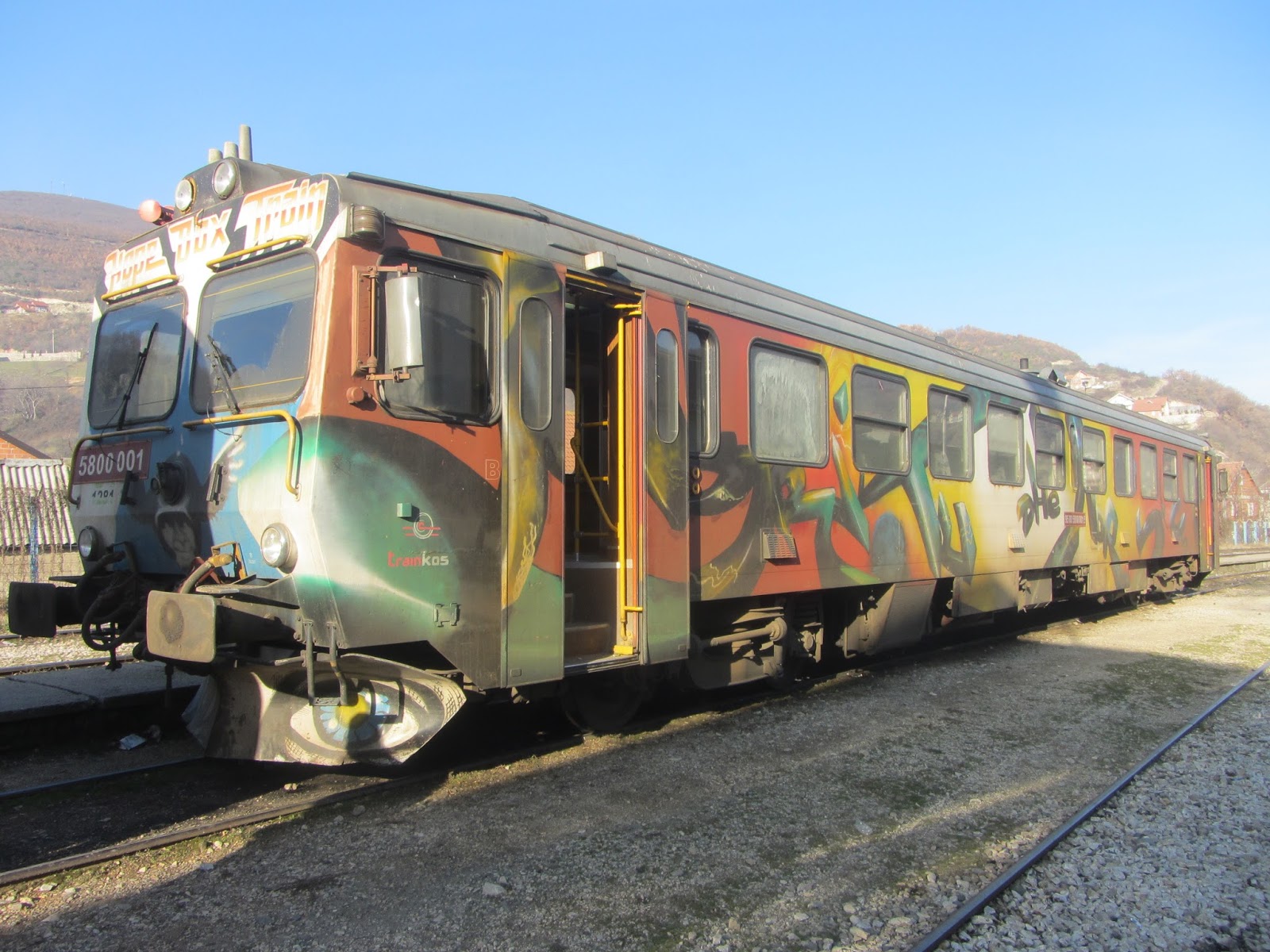
Travel tales on the internet suggested the train to Skopje should be a Kosovan carriage and a Macedonian carriage hauled by an elderly ex-Norwegian locomotive, at least as far as the border, where a Macedonian locomotive would complete the journey.  Quite disappointing then when a single vehicle diesel railcar turns up, being of Swedish origin,

I have no idea what 'Hope Box Train' means.  Here are customers milling about: we would not leave until about 07:45 as we needed to allow the Peje train to arrive along the single track in to the adjacent platform and it was running a little late. The morning Peje service was the return working of the departure I'd seen the previous night.

The interior of the train was battered.  It also had no heating, whilst a good number of passengers seemed to know the four (!!) customer facing staff.  During the journey timetable cards were handed out suggesting a new timetable in place, which may mean a permanent retiming for the 07:10 to 07:30.  As the Peje arrival is due at 07:32 in reality this probably means the Skopje departure goes a few minutes after this. Unfortunately I didn't realise he was handing out timetables until too late.

The Hope Box Train at Hani i Elezit.  Upon arrival we were motioned off this unit to join the single Macedonian Railways carriage immediately ahead.
Trainkos rail car up behind the Macedonian carriage

The Macedonian carriage carries quite an attractive livery behind the bodyside graffiti,  The graffiti was far from the biggest problem though - there is no loco attached to the carriage!  There was some discussion between the passengers and the inbound train crew/staff at Hani i Elezit.  As a result most passengers wandered off, later I realised they'd been told of a substantial delay (or retiming?) and reappeared with provisions 20 minutes later.  Most passengers took up the offer of the station staff to wait in their mess room!

A quick snapshot of what looks likes a new platform and station building, i suspect built with EU funds.  Neither were in use!  After about an hour we were motioned outside, just as Kosovan border police turned up.  As they checked passports, wrote names on a clipboard, and stamped us out the country, we boarded the Macedonian carriage. 
 
After about 70 minutes in Hani i Elezit and whilst waiting on the [freezing cold] Macedonian carriage, a train arrived from the direction of Macedonia, hauling what appears to be a piece of outsize cargo equipment from Zagrebtrans.

The locomotive was detached and ran around to the front of the carriage!

The carriage appears to be ex-Deutsche Bahn

And once again was in very poor condition.  About five minutes in to the journey we stopped at a border control point, and Macedonian police took passports from all the passengers.  It was a little concerning when we departed not having got my passport back.

I glanced down the corridor and saw the pile of passports in the hand of the train guard. As he made his way down the train selling tickets he also returned the passports.  The journey from Hani i Elezit to Skopje was 2 Euros.

 
The train made three station calls within Macedonia which are not shown on the Railkos timetable.  These were at Volkovo, Dorce Petrov, and Skopje-Sever.  At each the station master dutifully dispatched the train.


On arrival at Skopje, almost two hours late!

Skopje station has an impressive six platforms which appear quite modern (as well as a couple others in a  state of decay).

Modern lifts and design suggest this could probably be anywhere in Germany.

Unfortunately the station was deserted once the few passengers from Kosovo had left.

This is the ticket hall.

Another EU funded project.  I'm not sure what they envisaged gaining out of this unless it's part of the Trans European Network (TEN).

Just in case it is any use, I photographed this winter's arrival and departure sheets as well as another notice pinned adjacent to the timetables.


 What fun!  Thoroughly enjoyed this short but unpredictable journey!