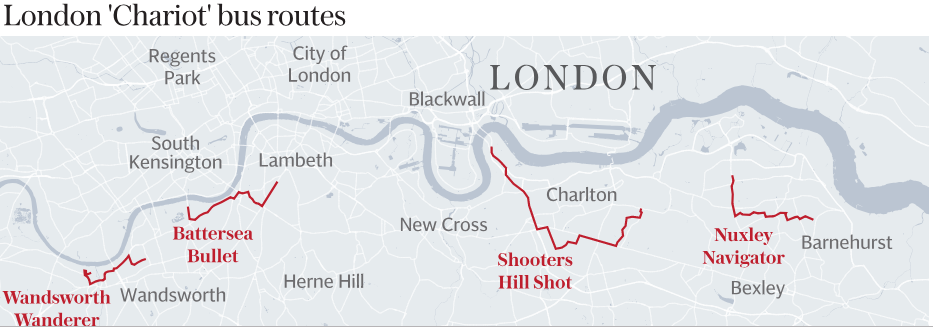
Back in September 2018 I took a ride or two on Ford’s then
new on-demand transport service ‘Chariot’.
I never got round to sharing my experience on this blog, but now the
Chariot experiment is
coming
to an end, I thought it’s time to reconsider chariot and the
on-demand/demand responsive/scheduled minibus sector, particularly in the
context of London.
The M1 & M2 Round Kirkhill Estate
The mid-1980s were a time of rapid expansion of minibus
services across the UK, as newly privatised bus operators sought cheap [van-derived]
vehicles to improve their service provision, or bringing private sector flair
to the market, if you will.
My own
experience was a large fleet of 16-seat
Freight Rover Sherpa
vans acquired by Northumbria Motor Services to provide increased frequency and
coverage of housing estates across Northumberland towns.
As this ‘boom generation’ of van derived buses reached the
end of their useful lives (and judging by the notices about engine replacement in
the cabs of Northumbria’s, this was at about two years old!) they tended to be
replaced by vehicles more recognisable as proper buses such as the
Optare Metrorider
or Dennis Dart, with increased capacity, and thus routes/frequencies reduced in
consequence.
The market for smaller
buses has largely remained with the community transport sector, where
specialist body builders are able to meet a broad range of accessibility
requirements.
These Aren’t Marshutkas
Fast forward to the last couple of years, and the van
derived minibus sector has made a return.
The beginning of 2017 saw both Arriva and Stagecoach operations in Kent
introduce Mercedes Sprinter based buses, Stagecoach under the ‘Little &
Often’ brand and Arriva as ‘Click’.
Little & Often featured bus seated Sprinters with all the bad things
about minibuses remembered: cramped aisle, no legroom, and now disabled access
regulations take away more of the seats.
Arriva’s initial vehicles were much better specified (leather seats on
bays of 4, USB charging, etc) but they admitted these early vehicles would not
be the specification rolled out across the country.
 |
| Stagecoach Little & Often |
Arriva Click’s justification is that it is more than a
regular bus service: it operates ‘on demand’ (in as much as a finite sized
fleet can do), and the concept has now expanded from
Sittingbourne/Kent
Science Park to south Liverpool whilst Sprinter minibuses have also been
acquired for other operations such as Stevenage, Hertfordshire.
Travelling with Click requires a little more
effort than a regular bus, requiring both the app and booking a trip.
Coming soon after Click was a two day trial by Citymapper,
running a minibus (again a Mercedes Sprinter) in a loop round central London,
which I
blogged
about at the time.
I still don’t
really know what Citymapper were doing, at the time I thought it was about the
sort of data they could collect about bus services, demand and reliability.
Looking back, they did then start an overnight scheduled bus operation in east
London (note, scheduled and bus, not on-demand and minibus).
The fact that has since ceased suggests they
actually thought they could run a bus service better than anyone else, and that
people would pay a premium for it (it was not included within London’s cheap
bus fares).
Ford-owned Chariot was the first modern day serious attempt
at a privately operated quasi-demand responsive minibus around highly residential
streets. Exactly what Northumbria did in
Morpeth, Cramlington, Ashington, Blyth and Whitley Bay in the late-1980s. The only different being, demand for Chariot
would be controlled by mobile phone app.
You book and pay for travel using the app. And I say only quasi-demand responsive,
because a set route was operated and appeared to operate to a set schedule,
assuming there were customers. Some
variation from the other operations described above though, being Ford-owned
the vehicles were Ford Transits.
 |
| Chariot app, see the location of every vehicle |
Journeys on Chariot start at a rail station,
before heading in the residential streets.
Therefore in the morning the vast majority (all?) demand was towards the
station and in the evening, away.
Reasonable to assume there’d be few counter-peak journeys, not many mod
journey alighters (in the morning) or boarders (in the evening).
Therefore, of a particular journey has no one
booked on it, it could presumably not run (though, I am not familiar with how
these
were
licensed by Transport for London, but as a non-contracted local bus they
would have some form of license to operate).
The Ability to Work
My first experience at trying to book Chariot was wholly
negative: I had the app, I had credit to travel, but it turned out that a
journey could only be booked once a driver was logged on in the vehicle being
used(!!!). So the average commuter
seeking a journey at 6pm couldn’t book until some time after 3.30pm when the
driver was at work. Being creatures of habit in the main, I’d expect an
intending customer might seek to book every day for the 6pm trip home.
Once that was figured, you got the name and picture of your
driver (like Uber’s app), a pick up time, and a booking code. The driver also got the same, on a tablet
device in lieu of a ticket machine. My first
driver was Peter, without a photo, and he was #944 (a meaningless number displayed
to customers, unless you happened to look at the fleet number on the van). On a busy trip the driver could check booking
codes and passenger images, but on my first trip from North Greenwich,
departing at 17:19, I was one of only two passengers for Peter. You can track the locations of not just your
van, but every van in service, on the app.
The Transit carried an attractive livery, but inside were, ultimately, a
typical Transit van, with high backed seats, no legroom, and a van rather than
bus interior.
 |
| Chariot ticket |
 |
| Trannies will never be known for their legroom |
I selected some random residential street to alight, but Peter
made no attempt to stop there or inform me that I was at my destination. I did ultimately alight in a randomly
selected street,
Mayplace
Lane. At which point I thought I’d
test the app and try and book myself on the next Chariot: low and behold Andrew
B (driving van 926) was four minutes away, and upon turning in to Mayplace
Lane, was looking out for me.
Now Andrew B was a whole lot more talkative, probably
because he really wanted to know why I was boarding an evening peak bus almost
at its terminus, which I am guessing no one ever does on Chariot. Andrew B was an ex London bus driver (I
forget which company) and was very enthusiastic about the Chariot USPs: almost
a door to door service, travelling with like minded people, on-board wi-fi, and
the ability to work during your commute.
 |
| Booking a pick up deep in residentialia |
Failure
The 1980s van-derived minibus scene largely returned to
operation by bigger buses running less often, with a few Mercedes 809Ds hanging on until
accessibility regulations prohibited their use.
The Stagecoach Little & Often concept
barely
lasted a year before it saw a largely similar fate.
Citymapper haven’t come back with any kind of
minibus/bus offering, and Chariot are not only closing their London operations
but their global operations, including New York, Los Angeles, Seattle, Chicago
and San Francisco.
In larger cities I do not believe a demand responsive
service appropriate or necessary. In the case of London the demand for travel
and urban density is such that those ‘on demand’ services have already progressed
in to a red bus every 10-15 minutes. The
prevalence of real time applications for tracking buses means that ‘booking’
simply isn’t necessary. Further, why
would you want to book when your journey plans could change: a few minutes more
at work, a connecting a Tube a few minutes late, a quick call in to Tesco
Express all mean a regular interval, unbooked bus service is actually more
flexible.
And that’s before we consider that as a Travelcard holder,
the bus journey is free at the point of use.
Chariot charged £2.40 per journey that was not included in any TfL
ticketing options
The lower seating capacity does not appear to be off set by
the lower operating costs of van derived minibuses. A Sprinter or Transit will have much more
easily accessible parts and servicing, and at least in the 1980s drivers on a
lower pay rate than their big bus counterparts.
Chariot in London operated for approximate three hour peaks
only. This makes driver rostering
difficult as a split shift is necessary, and results in long days, starting
before 6am and finishing after 7pm.
There were also proportionately high positioning costs, with buses returning
to their Battersea base between peaks.
Conversely a regular bus operating 18-20 hours day can be very
efficiently rostered to provide more drivers on shift at peak times.
The Chariot concept will never make money.
One area I didn’t understand about Chariot is how
mid-journey bookings were relayed to the driver. It suggests that either a pro-active check of
the tablet device is necessary, or that somehow it provides an alert to the
driver away from their line of sight.
Conversely, on regular London buses the iBus unit turns itself off when
the vehicle is in motion, as does the tablet-esque display on modern ticket
machines from Ticketer. Citymapper als equipped their drivers with a tablet
which blanked when the vehicle was moving.
Not All Negative
Rather than commuter services (which by their very nature
have known travel patterns, times and volumes) the demand responsive concept is
much more suited to situations where pre-booking is required for irregular
trips. This is likely to be in the community
transport sector, where the demand responsive element can genuinely respond to
mobility needs.
Van derived minibuses also have their place. The Spinters and Transits form the modern
backbone of the marshutka sector in the former Soviet bloc: marshutkas being
the ultimate expression of free market demand responsive transport.
 |
| Sprinter central! The long distance bus station in Chisinau, Moldova is a hot bed of van derived minibuses. |
 |
| Another appropriate use of van derived minibuses is providing public transport where conventional buses will not fit.... |