Wednesday, 22 November 2017

Hekurudha Shqiptare - Albanian Railways


The continuing quest to visit every country in Europe was aided in November 2017 by a £10 Ryanair fare from Podgorica in Montenegro to London.  An obvious one to team up with Albania.  For a long time Albania was the poorest country in Europe by quite some margin, with a leadership that complained of the right leaning tendencies of the Soviet Union.  Visiting in 2017 however found a country that was welcoming to visitors, did not seek to rip anyone off, and where attitudes and investment were quite liberal.  However such good fortune had not befallen Albanian Railways, on whom friends had previously experienced windowless bench seated carriages, and where the main station in the capital, Tirana, had been demolished. It is understood that lack of money for fuel meant Albanian Railways had temporarily ceased operating earlier in 2017.

Nowadays four daily return services are operated from the coastal port city of Durres, two to Kashar on the outskirts of the capital, one to the north of the country and Schkoder, and one in land to Elbasan, south-east of Tirana.

We went to use a Durres-Kashar service and found an unloved and unused railway.  Here it is in pictures....


The interior of Durres station with the staffed ticket window at the far end. Two singles to Kashar, about a 40 minute journey, came to barely one pound.

Outside Durres station is the entire rail timetable for Albania.  Prior to the demolition of Tirana station there were 6 or 7 round trips from Durres. In comparison the private coach operators combine to operate a 20-minute headway between the two cities.

The fare chart from Durres, featuring many destinations no longer served.

Curious poster advertising Albanian Railways (Hekurudha Shqiptare) promising many things which are not delivered, not least the Intercity 'swallow' livery High Speed Train and a working signal.

Two platforms and a siding are available at Durres station.

Waiting facilities are available.

Rolling stock is former East German (Deutsches Reichsbahn) carriages that were used in a unified Germany and therefore are largely in Die Bahn's red colours.  Many windows are missing from doors. Each window frame in the passenger saloons had glass, but was usually cracked, shot at or missing some or all of a pane of the double glazing.

An attempt has been made to tidy up some rolling stock, with new windows and a new paint job, but in the case of this one the paint has rapidly peeled revealing the old German paint job beneath.

The passenger rolling stock is also very heavily graffitied.

Albania's passenger trains are hauled by Class 669 diesel locomotives built in Czechoslovakia in the mid-late 1980s.  I observed that two carriage formations seem to be the norm with one carriage locked out of use.  Demand levels did not present a challenge to the amount of accommodation provided.

One Class 669 we saw had been painted in the new HSH branding, and this was to form our train to Kashar.

The reason for the limited, day time only, timetable becomes evident when you realise there are no signals. Every signal post is missing lights.  This results in a low speed infrequent line-of-sight railway.

Taking photos and videos from an Albanian train is made easier by the lack of windows in the doors.  There were four passengers on our train to Kashar so no croding in the vestibules!

Which is probably just as well as the wooden floor was rotten and cracking under foot.

Passenger saloon largely 'as received' from Germany with added antimacassars.  The seats and arm rests are falling to bits.

The view from the train somewhat restricted by the condition of the windows.

Another confidence-enduring signal post en route to Kashar.  There appeared to be some form of token working as we stopped twice between Durres and Kashar and things were handed to/from the locomotive.  There were also several manned hand-worked level crossings.

We stopped here en-route. No idea if it is an active station.

Same here, a more modern/better maintained facility.

Kashar station, the terminus.  Like everywhere on HSH it was well staffed.

Fare chart from Kashar.

At Kashar the locomotive runs around, not sure if it stabled or runs empty back to Durres.  Those bicycles outside the station? Kids who turn up to ride on the loco as it runs around!  For any train enthusiasts I am convinced that not many lek will score you a cab ride!

Another Class 669

And the final gratuitous train photo of a load more 669s at the depot just outside Durres.


Quite a few partially complete buildings are present along the line from Durres (which broadly parallels the main road, a dual carriageway, between Durres and Tirana).

However this is how the Albanians travel inter-city, on a series of privately owned/operated but remarkably well coordinated coaches and minibuses.  This is one of at least three coach stations in Tirana.
 Two more HSH shots.....making me glad I didn't go with the original plan of riding on the four hour trip to Schkoder!


Saturday, 9 September 2017

Lignes d'Azur - The Nice Tramway


Lignes d'Azur is actually the name of the municipal public transport undertaking throughout the Nice area.  It currently only has one tram line, through the city of Nice, alongside urban and inter-urban bus services.


The Nice Tramway serves the heart of the city's shopping centre, Avenue Jean Medicin.

Nice Tramway is operated by a fleet of five-section domestically built Alstom Citadis trams.
Clear maps showing tram lines and local buses are at each tram stop.

Real time information is at every stop.  I'm not sure of there's such a thing as a Tram court amongst the seemingly homogeneous fleet of Alston Citadis.

I do like a simple ticketing system.  Ticket choices are a single ('solo'), 10-trip carnet ('multi'), a one day or 7 day pass, or a ticket which includes the bus connection to Nice Airport, the latter attracting something of a price premium q.v.

And even better when the ticket machines looks exactly like the printed fare information.  Very simple to use.

Trams have next stop displays on board: like the ticketing these are simple and clear to understand.

As the Tramway rounds Promenade du Paillon the tram's track are sunk in to grass.  I think this helps a lot with the post-construction aesthetics of tramways. 

Information booth in central Nice about the planned extensions ti Nice Tramway.  Sadly, closed at the time of my nocturnal passing.

The bus service between Nice centre-ville and the Airport is operated by Mercedes Citaros as routes 98 and 99.  These two routes command a considerable fare premium, with a single fare of 6 euros, compared to 1.5 euros on other local buses. However the local buses are only a short walk from Terminal 1 on Promenade des Anglais.  It remains to be seen which pricing model the new tram adopts.

One final gratuitous tram shot.

MyCiti - Cape Town's BRT


In the summer of 2017 I took advantage of a cheap air fare to visit South Africa for the first time.  I included Cape Town on my travels, and as usual, sought to use local public transport to get around.  Prior to my arrival I was aware Cape Town had two separate bus networks, but wasn’t aware of the newer network’s adoption of some of the more interesting elements of bus rapid transit.  Having never been to Curitiba or Bogota it was my first time seeing ‘proper’ platform boarding on a bus.  I didn't have time for an extensive ride around the MyCiti system, but here's a few images from the travels I did make.


The Airport Station looks like the entrance to a metro system: the physical attributes and gate line do not suggest a bus-based service, or even light rail (which typically has open platforms too).

Airport services are in the hands of rigid Volvo B7Ls.  This one is at the down town 'Civic Centre' bus station,

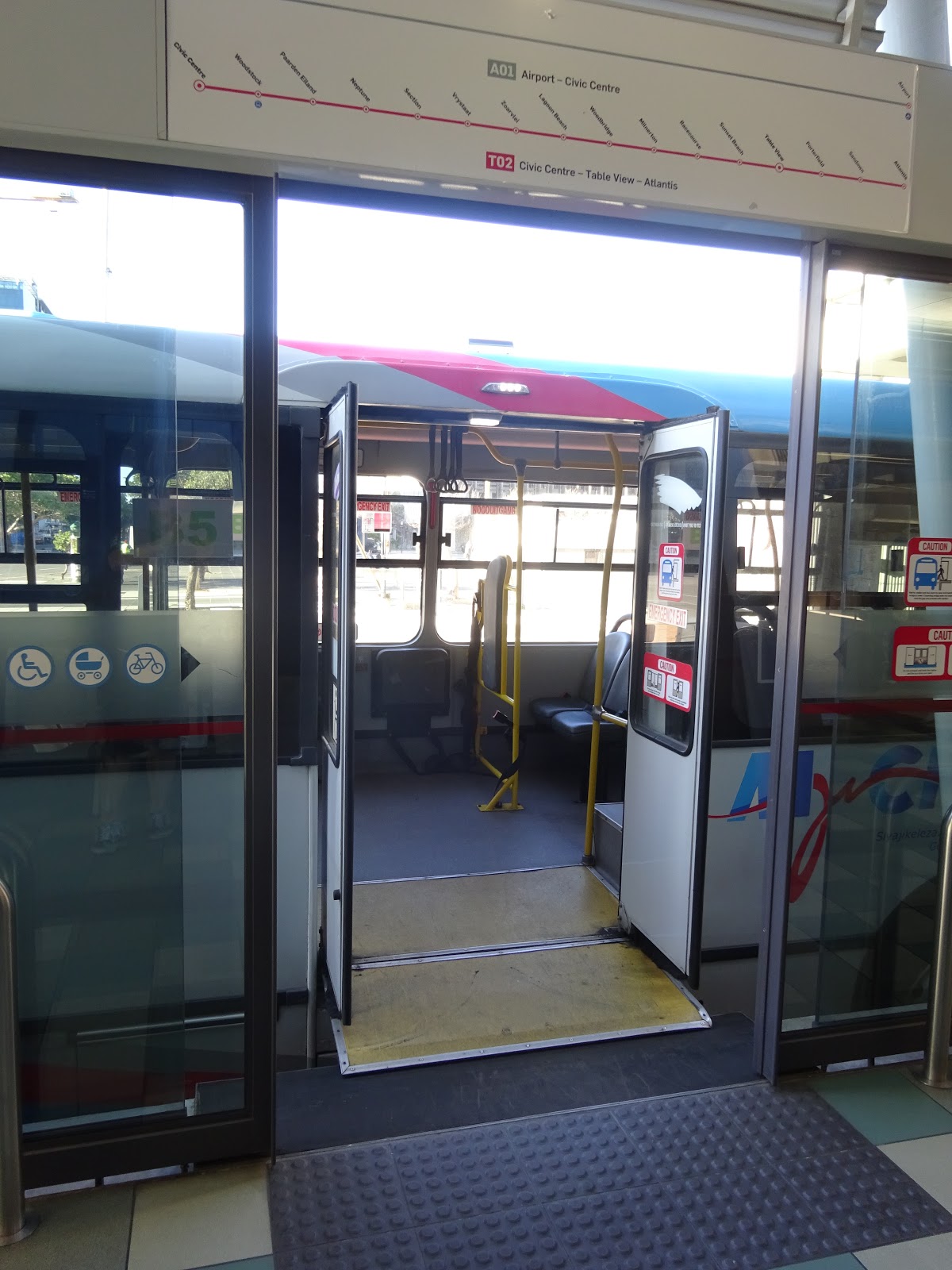
Some of the MyCiti vehicles have two third height doors and a ramp that folds out which also forms the bottom third of the door.

Some MyCiti services are operated by articulated Scania buses.  Most of the buses on MyCiti were constructed locally - I presume using chassis imported from Europe mated with a locally built body.

Boarding a MyCiti bus in the Civic Centre bus station.

On some buses the ramp folds down from inside the bus.  This is the Airport service, numbered A01.

The down town Civic Centre bus station has many boarding gates.

Entry to most of the MyCiti stations is via ticket gates.  There is a contactless smart card system: even single tickets from the airport are issued on a solid plastic smart card (rather than the paper tickets with a chip inside which some systems use, such as Glasgow Subway).  I believe the idea is that such tickets should be handed back and re-used, although the gates do not collect them automatically.  Beijing Subway uses a similar system for single tickets, where it is a smart card on entry but has to be inserted in to the gate for (re-use) on exit.

A down town Cape Town MyCiti station, with off-side boarding on a central island platform, and again showing ticket gates in use.

View of a MyCiti station from the outside.

Feeder services to MyCiti are also provided using locally built Optare Solo buses.  These have an offside door within the low floor area which necessitates the interchange stations to have two platforms: one at the Solo height and one for the high-floor height doors on the main MyCiti service buses.

Connecting buses at the Civic Centre interchange.  The rear vehicle is not in service as it is parked at a high floor platform.  The front two buses are at platforms which are commensurate with the height of the low floor section of the bus.

The connecting services also use conventional bus stops, such as this one at the V&A Waterfront.

Thursday, 6 July 2017

Crossrail Class 345


The first Class 345s for MTR Crossrail, the operator of the Crossrail/Elizabeth line service, have entered customer service operating off peak trips between Liverpool Street and Shenfield.  These are the initial application of the new Bombardier Aventra platform, and were expected in service in mid-May, but it took another six weeks or so before the public could get on board.  However once they could, it seemed rude not to go for a ride!

Initially just one train a day operated, at 10:35.  This was additional to the timetable...if it failed it didn't count towards Charter!

And this is what they replace, the humble Class 315.

One of the more unusual features of the '345, at least far as the public can see, is 26m long carriages (a first for the UK although the IEP will also have 26m vehicles) and three sets of doors per carriage. 

Class 345s made grown men and women take selfies.  With a train! 

The 'SFE' (sexy front end) might be the attraction, and looks rather sleek compared to the '315.  Also of note is these are first trains of recent times (since steam trains?) to not have yellow ends.  New regs mean sufficient brightness (luminoscity? lux?) from lights rule out the need for the yellow visible ends.

Until the end of 2018 the '345s will be operating as seven-car trains between Liverpool St and Shenfield.  Once operations commence through the Crossrail tunnel the final two vehicles will be added.

Designed for standing!  The interior of the 345 has plenty of standing room, tip up seats and longitudinal seating.  These will no doubt be extremely busy once running through central London, but like Underground S8 and Thameslink '700s they are both metro and commuter trains beyond zone 6 so some degree of compromise has been taken with the interior layout and availability of seating.  The bare metal grab rails are quite unusual, certainly unlike any other train in use in the south east, but will be familiar to MTRers who have transferred from Hong Kong operations.

Four bays of four seats are in each vehicle, two each between the three sets of doors.

There are modern flat screen customer information displays, although not as visually appealing as those on the Thameslink Class 700s. I found it surprising the service was mot described as the 'TfL Rail service to Shenfield'.  Indeed the driver made a manual announcement calling it an 'MTR Crossrail service to Shenfield'.  Announcing MTR Crossrail (or for that matter, Keolis Amey Docklands or Arriva Rail London) will only serve to confuse customers.
The automated system then decided we were skipping Stratford and our next stop is Maryland.  The driver's announcement confirmed we would be stopping at Startford.

People like shiney new air conditioned things, though these trains will be real crowd movers before too long.  They seem well built (I tried to break everything I could).  Clearly there's some teething problems which delayed entry to service and the very cautious single daily trip in customer service. Best to sort before out on all day diagrams, and as Roger Ford often says, nothing ever works out of the box!