Mulhouse is a city of about quarter of a million people, situated between Basel and Strasbourg in the Alsace region of France. It is not on the typical tourist itinerary, the greater Alsace region and the city of Colmar to the north being greater attractions. Mulhouse is close to the border with Germany, and air transport connections are through the Basel-Mulhouse-Freiburg 'Euroairport', itself a somewhat unusual design being in France, but with half the terminal and a fenced roadway classed as Swiss soil. Despite high fences the border can be crossed freely and without restriction inside the airport terminal.
There are two ways of getting from Euroairport to Mulhouse by public transport. From the Swiss side there is a bus to Basel central station every 7-10 minutes, whilst from the French side there is a bus every 15-30 minutes to St Louis station, on the Basel-Mulhouse line. If making this trip be aware that whilst there are two train services between Basel and Mulhouse, and they both stop at St Louis, they are only every 2 hours and timetables are not at all coordinated to provide an even headway!
 |
| The bus from Euroairport to St Louis is the ubiquitous Mercedes Citaro. 2.50 Euros each way for c. 10 minute ride to basically cross the motorway. |
 |
| There is a temporary access between the bus stop and the station..... |
 |
| ......quite unsuitable for luggage..... |
 |
| ......which appears to be caused by the construction of a tram line outside the station. As it is a narrower (1 metre?) gauge I assume it is planned to join up with the Basel system. |
 |
| The semi-fast service between Strasbourg and Basel is operated by the GEC/Alstom 'Sybic' class 26000 locomotives, with a rake of up to 11 coaches. This service is every 2 hours. |
 |
| There is an all stations service between Mulhouse and Basel operated by these 4-car Bombardier EMUs. This service is again every 2 hours. |
 |
| Local services to the north of Mulhouse are operated by these attractive 6-car Alston Coradia EMUs. |
 |
| There are inter-city services from Mulhouse to Paris and Strasbourg, originating in Zurich and operated by quite scruffy double TGV Lyria sets from Swiss Railways (SBB). Whilst hourly at best they were observed to pick up good loads necessitating a 3 to 4 minute dwell. |
 |
| Mulhouse's main station is a largely empty piece of concrete grimness. It would not be out of place several hundred miles further east. |
Suburban transport in Mulhouse takes the form of buses and trams, and is largely operated by Solea, under contract to the city municipality. Solea is a private company who's shareholders include RATP as well as Transdev. Like many French cities in recent years, Mulhouse opened a three line tram system in 2006; line 3 now continues past it's suburban terminus joins on to the main line rail network. These services are operated by SNCF tram-trains.
 |
| Mulhouse main station is the terminus of lines 1 and 3, as well as the tram traims which operate on line 3 and then on to the main line rail network. On the left is an Alstom Citadis of the Solea fleet, and on the right a Siemens Avanto tram train, operated by SNCF. |
 |
| All the tram stops in Mulhouse have a similar layout, with standardised facilities for printed customer information, real time information and ticket purchasing. |
 |
| Information and ticketing module at a Mulhouse tram stop. |
 |
| The ticketing is relatively simple, especially for travel within the city, where there is a flat fare and a one-day ticket. The latter is good value at 4 euros. The language option didn't work on nay of the ticket machines tested (on a somewhat unscientific sporadic test) however schoolboy French will get you though the common urban tickets. |
 |
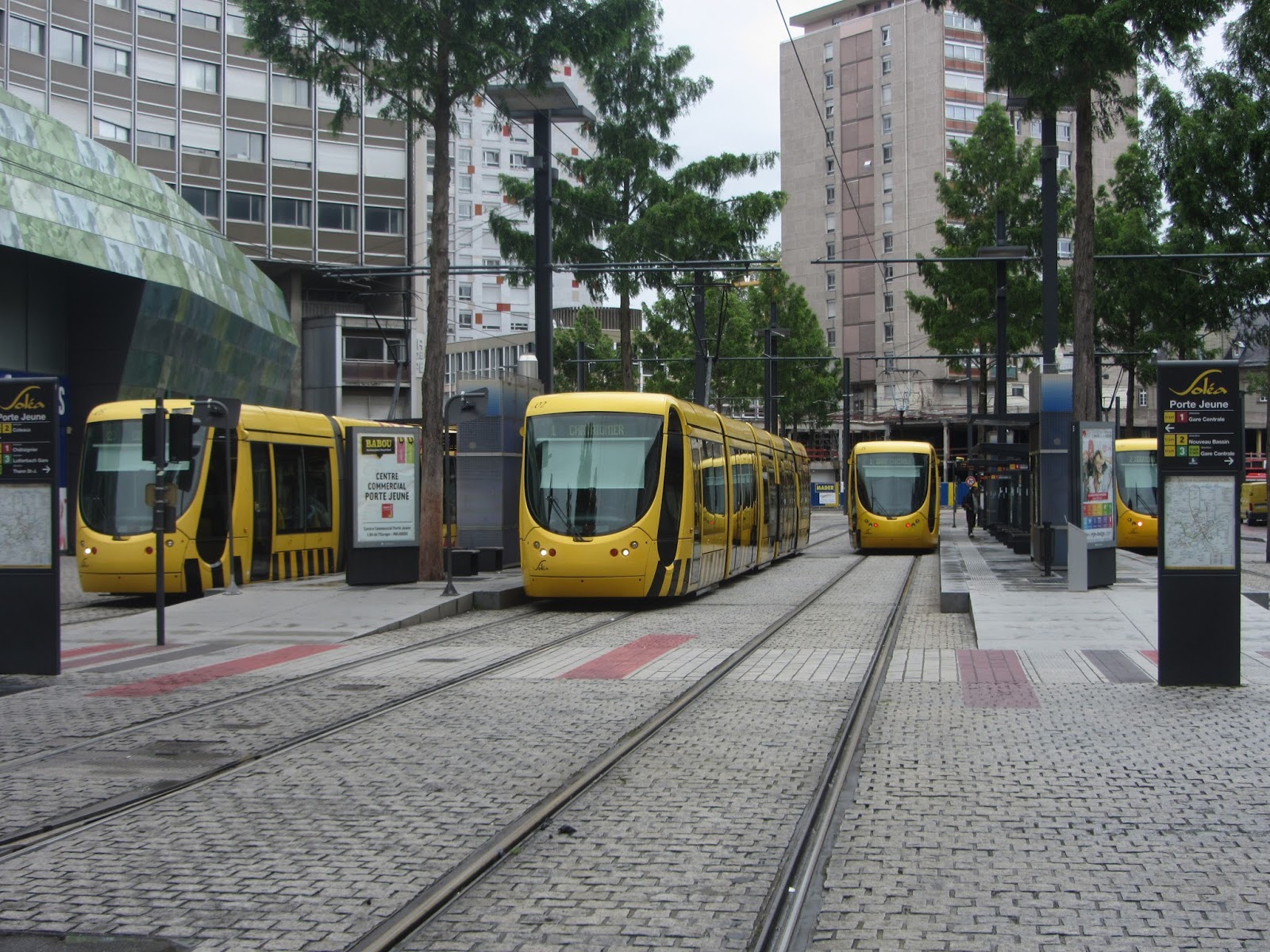
| An Alstom Citadis. This is the only type of tram operated by Solea in Mulhouse. |
 |
| A Siemens Avanto tram-train operated by SNCF. |
 |
| Tram lines 1 and 3 traverse the historic streets of Mulhouse between the central station and the city centre. |
 |
| Another great opportunity to put French lessons to use is the require to compost votre billet. Plentiful composters are available on board the trams. This only needs to be done once on the 24 hour ticket, which shows the time first used, enabling it to be used as a proper 24 hour ticket rather than 1 day ticket that expires with the calendar day. |
 |
| The tram system operates on a mix of segregated and on-street running, and has liberally used a grass setting (not grass-crete) to minimise the tram's visual intrusion. This is the terminus of line 1, in the centre of the road, with bus stops either side. |
 |
| This western terminus at Cotteaux of line 2 also has a headshunt set in grass. As can be seen this is a large housing estate, and the line passes by the city's university too. Line 2 is the busiest service, operating every 5-10 minutes for much of the day. |
 |
| Line 2 is the only line which does not service the central station. Instead it's eastern terminus (Nouveau Bassin) follows the same template as the other termini. As this stop is only 3 stops from the city centre it would seem there is opportunity to build an extension, and the alignment suggests this is in the minds of the city's planners. |
 |
| The northern terminus of line 3 is at Lutterbach, Line 3 operates every half an hour, with the tram-train on a sinmilar frequency resulting in a tram every 15 minutes. As the tram-train continues northwards and the station is on the alignment of the main line railway, there is no turnback headshunt. The rubber edge to the platform enables level boarding on to the Siemens tram-train vehicles. |
 |
| Lutterbach is advertised with SNCF connections. However there is one train a day in each direction on the main line! The following day's evening service will be a replacement bus ('car'). |
 |
| In the centre of Mulhouse all three lines (and tram-train) come together. Sunday mornings are quiet, and timetables are planned for interchange in the town centre allowing this photo of all 4 platforms occupied by Citatdi but without too many pedestrians in the way! |
 |
| Gratuitous tram shot. |
 |
| Another gratuitous tram picture. |
 |
| Tram in the centre of Mulhouse |
 |
| Gratuitous shot of tram-trains passing each other. |
Solea also operate the bus network in Mulhouse. The vehicle fleet is made of predictable Heuliez and Irisbus vehicles so common in France. However a couple of more interesting looking buses caught my eye at Chataignier, the terminus of line 1.
 |
| One of apparently only 2 Irisbus Crealis in the Solea fleet. Have ticket will travel.... |
 |
| ....and the return bus was an articulated Crealis. |
 |
| This is the interior of the articulated Crealis. It feels like an awful lot of bus for not many seats, where 1+2 seats and large equipment boxes fill the interior. |
 |
| Completing the public transport options in Mulhouse is a cycle hire scheme. Here's some bikes at a docking station. Not sure I saw a single one in use, but i was there over a weekend and a reasonable assumption (perhaps) that the system is busier during the week, |
So, my conclusion is that Mulhouse itself has a reasonable public transport network, with three tram lines forming its backbone, and a number of connecting bus routes filling in the gaps. Mulhouse is a small city and the tram network is reasonably comprehensive, although the extension of line 2 to the east might give access to trams for a greater number of residents (think Bakerloo line to the south), although this branch of line 2 does have a large P&R site, which may distort demand in to a large number of very short journeys during the week. I also got the feeling there is opportunity for development around the tram lines, both commercial and residential. I always worry about the long term sustainability of tram/metro systems when I see them running through fields!
There does however seem to be a much greater opportunity for travel to and from Mulhouse. Like so many places public transport is let down by a lack of imagination within the main line railway. The Strasbourg-Mulhouse-Basel service is every 2 hours with well loaded loco hauled trains: we saw up to 11 vehicles. This surely lends itself to a greater frequency, where journey time elasticity could reasonably be expected to deliver a proportionately greater increase in demand. There are no trains in the evening (do SNCF close at 8pm?) and no reasonable connections to Germany. There is a market to be tapped, which may be done by the likes of Flixbus rather than the railway.
 |
| At Basel station the trains from France use dedicated platforms, enabling a formal French/Swiss border. This is the exit from Switzerland to France. There are facilities for immigration and customs checks but I suspect it's many years since they were used. |