Monday, 4 January 2016

Bubbling over - Reading Buses' Claret Spritzer


Reading Buses have whole-vehicle route branding for many of their routes, including route names as well as numbers.  Jet Black, Lime 2, Leopard 3, Lion 4, Emerald 5/6, Scarlet 9 and so on, creating a colourful kaleidoscope/menagerie on the streets of the Berkshire town.  Route 21 is named Claret, with buses in an appropriate deep red.  The 21 passes through the University of Reading on its way to the Lower Earley suburb.  However, the University portion of the route generates more demand, which Reading Buses have the route 21a, and has been branded Claret Spritzer.  The brand and livery, as well as associated publicity, is the work of Best Impressions.  No self respecting public transport operator dare put a swirl or a swoosh on their vehicle without getting Best Impressions to make the most of it!  The Claret Spritzer has taken some mid-life 12m long Scania double deckers (at 12m, about 1-1.5m longer than most double deck buses) and developed a concept to appeal to student travellers......

Claret Spritzer 21a certainly is mixing up travel.

From the outside, an ordinary Scania bus, albeit with a bright livery, typical of the style used by Reading Buses.

Upstairs is where the Claret Spritzer comes in to its own.  At front is the 'work zone.'   Behind the work zone is the 'play zone', four tables with a bay of four seats around each. To the rear is the 'lounge zone'.  More on these follows.....

The Work Zone features 2+1 seating in a comfortable leather(esque, I suspect) moquette.  Yes that is a book shelf, with a borrow/replace honesty system.

Little distractions in the Play Zone.  Lego on this table....

....Connect 4 on this table.....

....and pure genius building Angry Birds game in to this table!


To the rear is the Relax Zone.  A 'U' shaped sofa wraps around the rear of the vehicle.  There are two USB charging stations (in opposite corner, each with two USB points) and two wireless charging points.  This isn't particularly innovative for Reading Buses though as USB charging facilities are standard on their vehicles.    Oh, I didn't get a picture of the jukebox just off the bottom left corner, but passengers can Bluetooth their phone to the bus.....

For anyone for whom the Spritzer is all a little bit too much, there are plenty of conventional bus seats downstairs.  Wood laminate flooring is becoming the new standard, whilst birds flying across the rear of the bus is rather more unique!

Whether the Claret Spritzer is a gimmick, whether the features are going to be used, whether the game of Connect 4 will loose all its pieces, who knows, but it's sure one smart vehicle to get people talking, and create a sense of 'engagement' with the customers.  It's not a bus for everyone, many bus users would shun such a vehicle, or dismiss the 'waste of space' upstairs but some features, USB charging, Wi-fi, even the presence of litter bins in the vehicle, are genuinely useful.  Bay seats of 4 always go first on trains, anecdotally they are popular on buses too.  And as a 12 metre vehicle, compared to most double deckers that are shorter, there's not that much space wasted.....

Sunday, 3 January 2016

The Great Western Railway....Thames Turbo


On Friday 1st January 2016 I made a rare venture out in to Great Western territory.  A "body on the line" delayed my departure somewhat, but I can't fault the announcements from the guard and then his patience explaining to every customer alternative travel options.  However the purpose of this post is the surprise I had when I went to catch a train from Reading to Newbury.  The train was formed of 3-car Class 166 "Thames Turbo" (as was) 166205 painted in the new Great Western Railway (GWR) branding, replacing the lurid First Great Western (FGW) livery.  I think the dark green and grey is quite understated and very smart.

I expected to find the interior unchanged, with the blue/purple/pink FGW seats, scruffy carpets, dingey doorways.  What I found was a real surprise, which was a fully refurbished interior.  Whilst the seats themselves are the same base, the first class has been reupholstered in a grey leather, which whilst sounding bland looked quite appealing to sit in.  Only had a standard class ticket however, where the seats remain 2+3 but reupholstered in a green and two-tone grey moquette, again far from the worst seat pattern out there.

Further down the train the toilet area has been completely rebuilt, presumably taking advantage of the refurbishment to meet forthcoming accessibility regulations.  This area includes dedicated space for wheelchair passengers, and in a nice touch has a half-height partition between the toilet and the wheelchair area: I always feel the wheelchair area stuffed next to a toilet (as on the Electrostars that GWR will be getting) is unwelcoming at best.


Bodyside detail, unusual way of showing the operator name in a matt green band, but it works.  No 'flying F' logo either!

Overview of the GWR 166.  Quite an appealing livery I think, nothing can be done about the big yellow end which looks out of place!

GWR 166 First Class.  I believe these are the original seats but rather more welcoming,

Overview of reupholstered Standard Class seating and new carpets.

Disabled toilet and wheelchair area.  The wheelchair area is partitioned from the toilet (good) but doesn't have any further comfort factors such as a small table or drop down seat for travelling companions.

The new paler moquette is sadly easily stained, and in my short time on this train I overheard a couple of negative comments from passengers about these.  If only passengers would treat trains like their own house eh.  Nonetheless this shows these refubished units will be a challenge to keep presentable and suspect a darker moquette will be required.

The rebrand from First Great Western is not an overnight hit: most trains still carry the purple FGW livery, a lot of signage is still FGW branded, staff still wear FGW uniforms and some leaflets are still FGW stock (timetables being an exception as these are reprinted regularly).  The delayed train and compensation leaflet is in new GWR green, but explains compensation for delays in terms of whether you are on a former First Great Western, First Great Western Link or Wessex Trains service!  These three came together to form the current franchise on 1 April 2006.  Reference to former TOCs is as good as meaningless, it's been nearly ten years since two of them existed.  This should be simple one for the DfT to sort as part of the franchise extensions on GWR....you'd have thought.....

Darlington bus brands

Passing through Darlington at Christmas it struck me just how many brands there are associated with the buses in the town.  This isn't  case of competition confusion, or of smaller operators providing niche services, rather, it seems to be over-active marketing departments.  All services are provided by Arriva, but the customer is faced with these brands:

  • Arriva
  • Frequenta
  • Sapphire
  • Max
  • Whoosh
  • Darlington Borough Council
  • Localmotion
  • Connect Tees Valley

All seems a bit excessive to me!

The most common brand is 'Frequenta' on the buses around the town, mainly longer Opare Solos.  Once upon a time this was United 'Roadranger'.

Max is an Arriva brand that no one really understands - theoretically older buses refurbished to a higher-than-average-but-not-quite-Sapphire standard, but these Streetlites don't fit the age criteria.

Sapphire is an Arriva service proposition that makes your everyday journey sparkle!

Frequenta buses aren't just turquoise Solos, they are also green MAN gas buses.

However the green MAN gas buses can also be 'Whoosh' buses if you're going to Peterlee/Sunderland. 

Bus stop flags are primarily branded 'Connect Tees Valley'.  Many of them carry a haphazardly-placed Frequenta sticker, but does make you ask whether only Frequenta (town, local, 'Roadrunner'.....) services stop there.  The statement 'All services' is particularly unhelpful as it actually means 'All services that are planned to stop here'.  At least at-stop timetable information is reasonably good.

However the at-stop information is branded by Darlington Borough Council and Localmotion.  Localmotion was the project name for the DfT 'sustainable travel town' demonstration project a few years ago.
Wouldn't it be good to rationalise this confusing array of brands (and no doubt websites) and focus on one brand for town services (Localmotion sounds better than Frequenta, and has a bit of local history to it), and  for the wider Arriva to work out what Max is.  This would work if affected parties adopted the spirit of cooperation, but I suspect for as long as different bodies have responsibility for running, buses, installing flags, and printing publicity, they'll all want their own brands(s) promoted.

Wednesday, 23 December 2015

eInk, or electronic paper - slowly fading away?


It only came to my attention today that TfL has been trialing eInk/electronic paper at a bus stop on Westminster Bridge.  And that was only because the Evening Standard ran a story on it!  The bus stop chosen is 'P' on the northbound approach to Waterloo Bridge, a very busy bus stop adjacent to the Imax cinema.  The display is very similar to an Amazon Kindle.
     

The photos which accompanied the Evening Standard story show the date on the bus stop as 12th November 2015.  So this has passed me by for a few weeks!  The technology is promoted by Smart City Displays and Technoframe - they share a phone number so are the same company.  No idea why they have two trading names both promoting the same thing.  Anyway, the jist is that screens can be installed at a bus stop showing whatever information is desired, in the example above the next bus on every route departing from bus stop P.  The promo shots show the display in sunlight and in darkness, proving it works in all weathers.  The photo above, at obligatory natty angle, is from one of their websites, also showing the 12th November date.

So when I visited on 23 December at dusk, the reality is more like this.  It is visually unappealing, looking more like long since abandoned, faded, and water damaged bus timetables left in a shelter and not the sort of thing TfL typically provides at bus stops.  I tried pressing the button at the top (on some bus stops this provides a back light to help read the display at night) and the three blue/red/green coloured buttons at the bottom.  None of them did anything, though some press releases suggest the bottom buttons should change a page.
A close up of the display.  It is very faded, almost like constantly displaying the same colours has burnt out the ability to show clear information (I'm no techy expert on the technology behind this display.)  The header band and route numbers will only have limited changese so unlike the Kindle where page content is constantly changing, this eInk has to be able to show the same imagery for all its life - I'd expect 5 years minimum.  This image showing routes 243/341/521/RV1 looks like a second page as the previous photo showed routes numbered between 1 and 188.  Observation of passengers at the stop showed they had no interest in it - the printed linear diagrams were of much more interest to the largely tourist crowd waiting at stop P.

Over the last decade or so TfL has used 'Countdown' displays within bus shelters to provide at-stop real time information.  They seem quite reliable and are probably quite simple technology in themselves.  Photo from tfl.gov.uk.  TfL also has web-based real time information (as do some mapping sites) and a text-back service from every bus stop, though awareness of the latter seems quite low.

In these days of high levels of smart phone ownership there are numerous apps available showing real time bus times, all using the same data from the TfL iBus vehicle tracking function as is used in TfL's own applications.  This is one simply called Bus Times which I use, and this screenshot is showing comprehensive information for the same bus stop on Waterloo Bridge.  I appreciate it is less likely that a visitor/tourist especially from overseas will have the data allowance to run the app, but data is getting cheaper (and at no additional charge across Europe from mid 2017) and wifi is getting more common, so in the goodness of time this could become the preeminent way of giving real time bus information.
Th eInk technology is also proposed to be used on bus destination displays (and recent evidence with how in or out of touch I am, may already have happened).  Image from Technoframe's website.  The paper blind is a pretty reliable and clear way of describing bus information - eInk needs to work a lot better before it is released in to the mainstream, at bus stops, as bus destination displays or otherwise.  I am also unsure exactly what problem eInk is seeking to solve, especially with the bus stop displays,

Tuesday, 15 December 2015

Fake Borismaster aka the Enviro 400 City

The Borismaster, initially officially called the New Bus for London (NBfL), 'LT' type, and latterly the New Routemaster (NRM) has been a controversial bus introduced over the reign of Boris Johnson as London mayor.  Say what you like about the BM/NBfL/LT/NRM it was a commitment he made, Londoners voted for him (just) and he's delivered that commitment.  Over the weekend of 12/13 December the 600th NRM entered service, one of the first NRMs for Abellio London for route 159, which they also started operating on the 12th.  Transport for London has ordered 800 NRMs in total (plus a few prototypes) which they allocate to routes and operators.

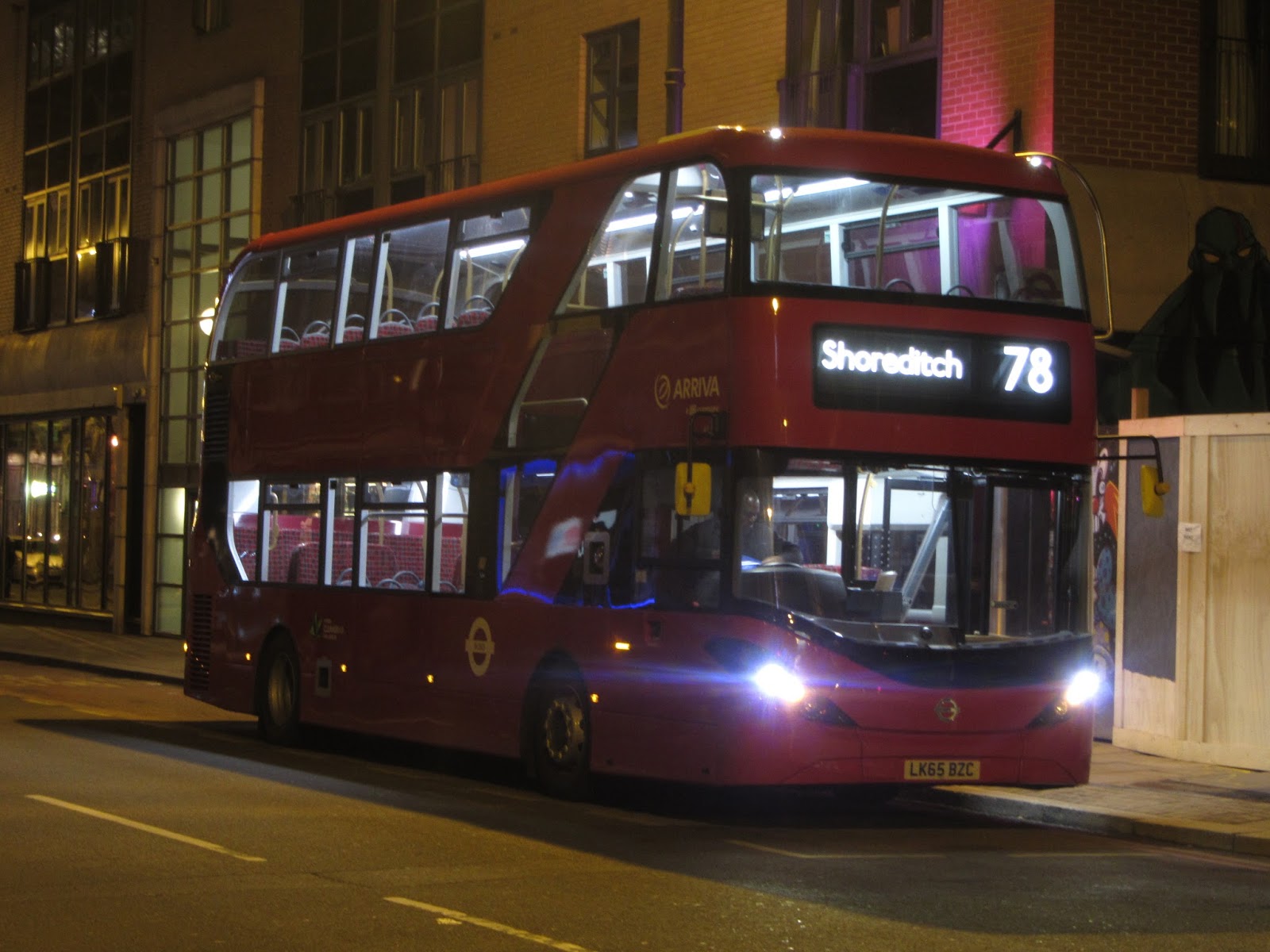
However, somewhat more quietly, Transport for London has also been working with the UK's other big bus builder Alexander Dennis to restyle their Enviro 400 workhorse to resemble a NRM.  This type was first revealed at the Coach & Bus Live show in Birmingham NEC in October, and also entered service over the weekend of 12/13 December, this time in the hands of Arriva London on route 78 (Nunhead-Shoreditch).

1) Rapid evolution of the Enviro 400: 14, 64 and 65 plate vehicles shown

A 2014 Enviro 400, this one being a National Express West Midlands vehicle in West Bromwich,

Evolved in to the Enviro 400MMC (Major Model Change). Supposedly doesn't rattle. At all.  This one is a 2015 example with Abellio in Croydon.

And by the end of 2015 the Enviro 400 has morphed in to this, NRM-esque styling. Compare to the NRM below.....

2) A NRM (below) for comparison to the Enviro 400 City above

Stagecoach NRM LT246. Similarities to the Enviro 400 City - they're red, they have the TfL roundel on the front and the windows up the staircase (Wrights are also offering the latter on their new buses so it may be the next big thing?).  However there are enough similarities that the person on the street might think they are on an NRM/NBfL/Borismaster,

3) The Enviro 400 City

Looking forward it instantly looks more like a regular bus. Big windows. That open!

The air cooling unit common on modern London buses alongside the diagonal windows and panel up the stairs, very much a feature of the NRM copies on to the E400City.

Looking back it is clearly not an NRM: there;s no rear staircase.  However the RM/NRM terracotta interior paneling is retained, as are gold grab rails.  The wrap-up rear window is unusual, but is a style Alexander Dennis have adopted for their new single deck buses too.

And finally the moquette.  The latest evolution in the TfL boxy stripes moquette now includes roundels.  I think it looks superb and could be a new standard across all modes.

And finally: by the no. 78 bus stand (also used by 47s) in Shoreditch is a bar glamming up Far Rockaway,  Sadly it was closed, else I'd have gone in and told them Far Rockaway sounds far more exuberant than it actually is, being a windy cold terminus of the New York Subway with a distant view of Kennedy Airport!
Terminus of the NY Subway A Train: Far Rockaway. Absolutely nothing there, and it might look sunny but it was freezing!

Sunday, 6 December 2015

Twin Cities of Minneapolis and St Paul - Metro Green Line

The Green Line of the Minneapolis/St Paul Metro is a light rail route which opened in 2014, linking the twin cities.  The majority of the route is in the median of University Avenue.  Stations are also built in the median.
As would be expected for a brand new system, signage is smart and consistent. Typical of public transport is an explicit list of rules.

Stations are all built to a consistent design.  The shelter doesn't look like it would be very effective in a cold northern winter in wind, snow ice and rain!

A good set of information is provided at every station.  It looks well maintained.

M/SP Metro has a smart card ticketing system called Go To.  This is one of the validators, where you need to select the fare as well as validate the card.  I'm not sure why/how this works as the system operates on a flat fare system.

Ticket machines. One per platform.  Simple to use.

I would assume anyone wanting some kind of travel card or Go To electronic ticket would research first.  For a one way ticket in to St Paul there is a flat fare.  It should be noted there fare is 50cents higher in the AM and PM peak.

Entry to the 'paid' side is denoted by these paving stones!  I'm sure that was a stroke of genius by the scheme promoter but they are very easy to miss, as I did at first.

A fleet of US-built Siemens light rail vehicles operates the Green Line.  These appear to be a standard LRV in the USA but have limited applications in the rest of the world. 

Tip-down seats mean you have to tip all 3, which isn't good if you were to have, say, a parent and a baby in a buggy travelling together,

Simple line diagrams above each door. As well as the route between the two cities there is also light rail service to the Minneapolis International Airport and the Mall of America (either the largest or second largest mall in the USA, I forget which!)
 
Space for bicycles is provided in each LRV.  This is typical of unexpectedly-good provision for cyclists on US public transport.

However some seats have about 3 inches of legroom.  You'd think Siemens would do better!
The Green Line service is operated by up to  three LRVs in a single consist.  After the PM peak I observed single vehicles being detached at the St Paul terminus to run back in to the depot.