Sunday, 6 December 2015

Twin Cities of Minneapolis and St Paul - Metro Green Line

The Green Line of the Minneapolis/St Paul Metro is a light rail route which opened in 2014, linking the twin cities.  The majority of the route is in the median of University Avenue.  Stations are also built in the median.
As would be expected for a brand new system, signage is smart and consistent. Typical of public transport is an explicit list of rules.

Stations are all built to a consistent design.  The shelter doesn't look like it would be very effective in a cold northern winter in wind, snow ice and rain!

A good set of information is provided at every station.  It looks well maintained.

M/SP Metro has a smart card ticketing system called Go To.  This is one of the validators, where you need to select the fare as well as validate the card.  I'm not sure why/how this works as the system operates on a flat fare system.

Ticket machines. One per platform.  Simple to use.

I would assume anyone wanting some kind of travel card or Go To electronic ticket would research first.  For a one way ticket in to St Paul there is a flat fare.  It should be noted there fare is 50cents higher in the AM and PM peak.

Entry to the 'paid' side is denoted by these paving stones!  I'm sure that was a stroke of genius by the scheme promoter but they are very easy to miss, as I did at first.

A fleet of US-built Siemens light rail vehicles operates the Green Line.  These appear to be a standard LRV in the USA but have limited applications in the rest of the world. 

Tip-down seats mean you have to tip all 3, which isn't good if you were to have, say, a parent and a baby in a buggy travelling together,

Simple line diagrams above each door. As well as the route between the two cities there is also light rail service to the Minneapolis International Airport and the Mall of America (either the largest or second largest mall in the USA, I forget which!)
 
Space for bicycles is provided in each LRV.  This is typical of unexpectedly-good provision for cyclists on US public transport.

However some seats have about 3 inches of legroom.  You'd think Siemens would do better!
The Green Line service is operated by up to  three LRVs in a single consist.  After the PM peak I observed single vehicles being detached at the St Paul terminus to run back in to the depot. 

Toronto Streetcars

In October 2015 I finally visited Toronto as a tourist.  It is a fantastic city with plenty going on, not least the filming of one of my favourite TV shows, Suits (ostensibly set in New York).    The highlight for the transport professional has to be the tramway, or street car, system.  Toronto's public transport is operated primarily by Toronto Transit Commission (TTC) who have a wonderful pseudo-communist logo.  This blog will focus on street cars, with brief mention of other modes at the end.

The Toronto Transit Commission (TTC) logo looking a little hammer & syckle-ish outside the Toronto Subway

We wanted to buy a day ticket for the TTC.  The street cars appeared rely completely on off-system ticketing, so the obvious place to go was a Subway station.  This is where we discover Toronto ticketing is stuck in the early 1980s.  I don't recall what the token system was for but surely wasn't the day ticket!  Apparently single fares can be paid to the driver on boarding.

So you want a day pass, you'd go to a machine titled 'passes' yes? No!  You suspect the screen is a shiney front for a very retro machine inside!

Having concluded the only way to buy a day ticket was to talk to a staff member, the principle of Group Station Manager caught me eye.  Anyone would think there were several ex-London Underground managers working for TTC!

So the day tickets had to be bought from a TTC staff member in a passemiter type facility.  Who'd have thought in 2015 that a major western city would be using scratch cards for day tickets?

Toronto street cars tend to run in the centre of the road.  Stops are marked by these fairly subtle posts, usually just before a crossroads (Toronto is largely laid out in a typical North American grid pattern).  When the tram stops in the outside of two lanes traffic has to stop on the nearside lane.  Toronto is far from the only city that uses this system but any road safety audit would surely decree it insanity, particularly as alighting passengers could step in to the path of oncoming traffic.

Close up of the at-stop information.  Route 504 on King goes through the heart of the city and was observed to suffer from some bunching of vehicles.

Toronto's street car system is run primarily by late 1970s/early 1980s cars manufactured by Hawker Siddeley in Thunder Bay, Canada.  The vehicle was intended as a new standard called a Canadian Light Rail Vehicle (CLRV), and whilst it was not adopted elsewhere, nearly 200 are in service in Toronto.  The CLRVs replaced PCC cars, one of which operates on San Francisco's (wonderful) F line in Toronto colours.

One of the problems with operating genuine street-cars is the lack of segregated running that a modern system or a metro has.  Here is a CLRV in traffic on route 511 on Bathurst Street.  The main line railway in to Toronto goes over the bridge.

There is also an articulated version of the CLRV called an ALRV.  These date from the mid to late 1980s and operate three of the eleven TTC Streetcar routes.

The conventional 'trolley' system of motive power means there is a strip on the rear of every vehicle that never gets washed!
The CLRVs and ALRVs are currently in the process of being replaced by 'off-the-shelf' Bombardier Flexity trams.  The Flexitys are twice the length of the CLRVs.  The first Flexity trams entered service in 2014 but delivery seems to be quite slow.

CLRV vehicles on the waterfront lines 509/510.

Route 512 to Keele starts at the St Clair East interchange with the Toronto Subway, where the signed exit from the Metro leads on to the Streetcar platform. It further interchanges with the Metro at St Clair West.

The route 512 runs along St Clair. At St Clair West station it dips in to an underground interchange with the Subway and local buses.  I found this quite a fascinating place to watch trams go round a bus station.

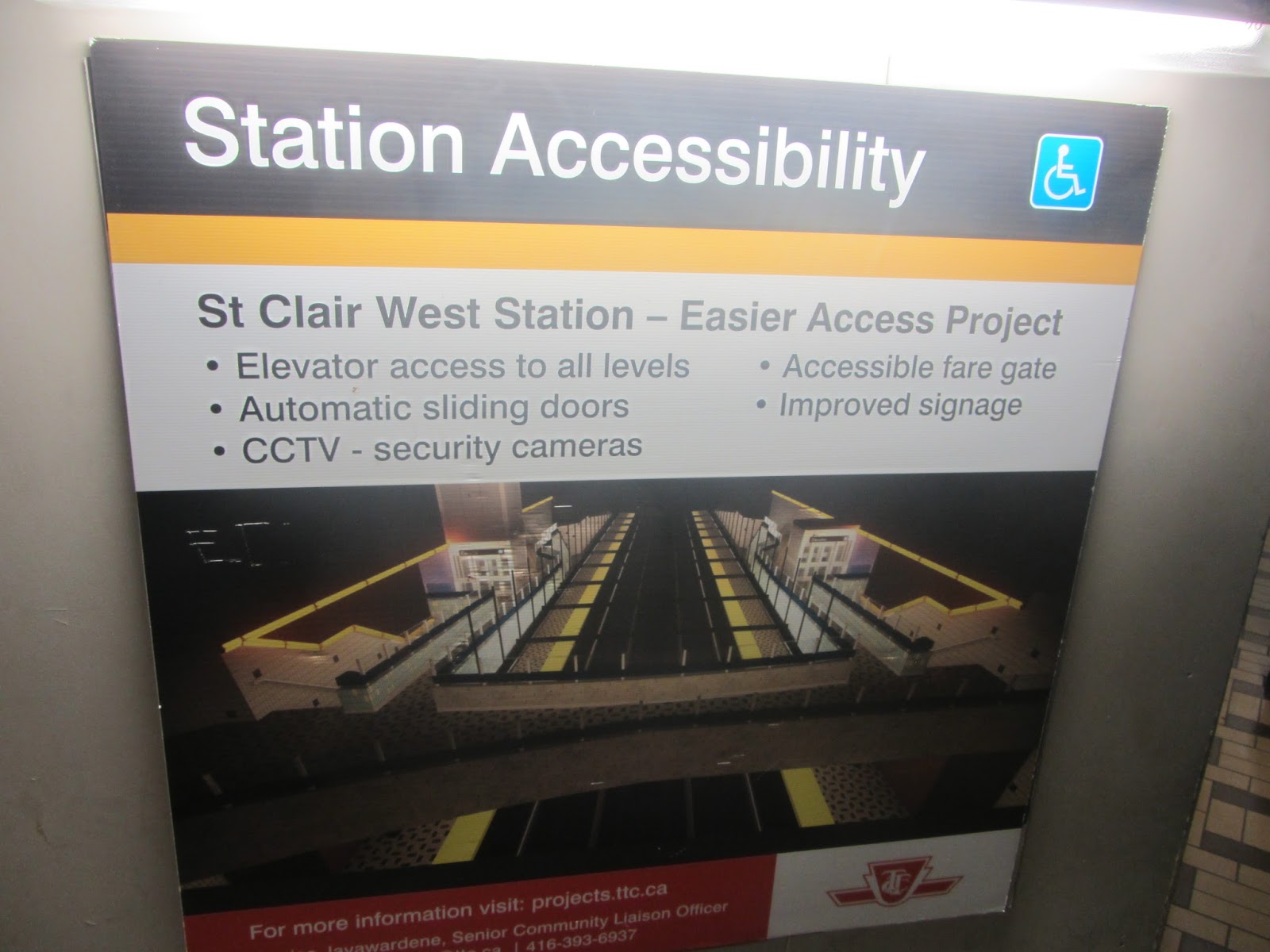
There are signs of investment in the TTC network, which has the impression of a system that may have gone many years without significant expenditure upon it.  ST Clair West is going to be a beneficiary,
More signs of change - which may be influenced by the aforementioned Brits in senior positions at the TTC.....

Interior of the CLRVs does not hide their 1970s design.

Overview of the interior of a CLRV.
Gate line at St Clair West.  Notable that the gates apply to the bus and streetcar stops as well as the escalators down to the subway.  Two things of note: 1. the ticket seller merrily laughing at my activities, and 2. the complete uselessness of the scratch-off day ticket in these gates!


Gratuitous CLRV photo.

And another CLRV.

And another!
Flexity at night.

I don't have enough to review the Subway, but here's an Alexander-Dennis Enviro 400, a product of Falkirk, Scotland, in use as a sightseeing bus in Toronto.  Some 220 more Alexander Dennis double deckers are set to join operations in Ontario.

Thursday, 29 October 2015

Crossing the broken Circle line

Tonight I travelled on a lesser-frequented part of the Underground network, joining the Outer Rail (or Clockwise to the layman) Circle line at Notting Hill Gate.  Despite the S7 Stock trains having been in front line service on the Circle for a good couple of years now, the platform length issues in this area have escaped my recent attention.
Notting Hill Gate Inner Road (anti-clockwise).  The end of the platform is the white barriers on the centre left of the photo, whilst the stop marking for the train is the green and yellow marking to the centre right!  Quite a considerable amount of Circle line and District line (Wimbledon-Edgware Rd service) berths outside the platform.

Notting Hill Gate station. Beautiful, love these cut & roof (rather than cut & cover) stations on the west side of the Circle.  Camera phone does not handle light very well.

On the Outer Rail the tail end of the train, the final two sets of doors, berths outside of the platform. As can be seen the doors of course remain closed.  I assume the same end of the train is used in both directions so the internal stickers, see below, are only at one end.  And I'm writing that trying desperately to think if an S7 could be turned so that the stickers could ever be at the wrong end, and I think that would only be possible is one ended up going round Watford North Curve (post script: this is a ridiculous statement, two minutes more thought and I realise it can easily happen around Cromwell Rd Jn swapping between District and C&H services) - and I think something would have gone seriously wrong for an S7 to end up there!

View from inside the train berthed outside the platform. Move along!

The rear two sets of doors (Outer Rail) - and therefore front two sets on the Inner Rail - have this notice about doors not opening at some stations - the same doors do not open at Bayswater and Paddington (District/Praed St) whilst the sign illuminates in stations.  Talk about bespoke rolling stock!

Heading to King's Cross the cross-platform interchange off the terminating Circle on to the through Circle was almost seamless.  Here's a Hammersmith to Edgware Road train passing through Edgware Road for the first time on its trip.

The S7 in my opinion parallels if not betters the finest metro style rolling stock in the world.  Spacious. clean lines, big doors, walk-through, great customer information.  Work trips with shorter ladies has established a lack of grab rails in some places but far worse exists on the fabled Far Eastern metros!

At Baker Street all three sets of doors in the rear vehicle do not open (this will be the leading three in the opposite direction).  Here's an 'arm-selfie' of what the customer sees through the door!

As an extra set of doors is problematic just at Baker Street, there is a Baker Street-only sign on this set!  There are also visual and audible announcements in this car about doors not opening.  Doesn't stop people trying to get out though!
And I had a quick look at some recent developments on the King's Cross St Pancras London Underground station.....

Memories of 2012:  mass swathes of 'Olympink' have found their way on to the network for the Rugby World Cup. The final is this weekend though so expect to see it come down pretty soon.  The Olympink has become the standard for ad-hoc event signage - it was also used for the Tour de France in 2014. 

However, genuine Olympics signage remains at two lifts (at least, that I saw) at King's Cross St Pancras - they have survived well for 3+ years.  Let's hope they never go!

The new London Underground retail and staffing model has seen many ticket offices close.  The requirement for ticketing capacity at KXSP has seen large new suites of passenger-operated ticket machines installed - the foreground of this picture used to be a conventional ticket office.  I also once spent a spectacularly dull shift assisting at this bank of ticket machines!

The new retail and staffing model has seen 'Visitor Centre' spring up to replace some of the softer functions of the ticket offices.  In bloody pink.  Eurostar trains are still arriving at St Pancras International all of 200 yards from the Visitor Centre: this is the main entrance to the Underground for Eurostar passengers.  It is all brightly lit up and welcoming but is it open? You can guess the answer to that......
Transport for London unwittingly found itself in the press earlier this week, when it installed an automated foreign exchange machine in immediate proximity to the 7/7 Memorial at King's Cross St Pancras.  The photos in the link show it does change the focus from the memorial to the exchange rates.  Well, three days later it has gone. No idea where to.
And here is evidence of it's removal.  The bags by the way were attended just I chose to not include the attendee in shot (and it was a +4 on to my Thameslink train home so I didn't hand around waiting for the bags' owners to move on).