Sunday, 6 December 2015

Toronto Streetcars

In October 2015 I finally visited Toronto as a tourist.  It is a fantastic city with plenty going on, not least the filming of one of my favourite TV shows, Suits (ostensibly set in New York).    The highlight for the transport professional has to be the tramway, or street car, system.  Toronto's public transport is operated primarily by Toronto Transit Commission (TTC) who have a wonderful pseudo-communist logo.  This blog will focus on street cars, with brief mention of other modes at the end.

The Toronto Transit Commission (TTC) logo looking a little hammer & syckle-ish outside the Toronto Subway

We wanted to buy a day ticket for the TTC.  The street cars appeared rely completely on off-system ticketing, so the obvious place to go was a Subway station.  This is where we discover Toronto ticketing is stuck in the early 1980s.  I don't recall what the token system was for but surely wasn't the day ticket!  Apparently single fares can be paid to the driver on boarding.

So you want a day pass, you'd go to a machine titled 'passes' yes? No!  You suspect the screen is a shiney front for a very retro machine inside!

Having concluded the only way to buy a day ticket was to talk to a staff member, the principle of Group Station Manager caught me eye.  Anyone would think there were several ex-London Underground managers working for TTC!

So the day tickets had to be bought from a TTC staff member in a passemiter type facility.  Who'd have thought in 2015 that a major western city would be using scratch cards for day tickets?

Toronto street cars tend to run in the centre of the road.  Stops are marked by these fairly subtle posts, usually just before a crossroads (Toronto is largely laid out in a typical North American grid pattern).  When the tram stops in the outside of two lanes traffic has to stop on the nearside lane.  Toronto is far from the only city that uses this system but any road safety audit would surely decree it insanity, particularly as alighting passengers could step in to the path of oncoming traffic.

Close up of the at-stop information.  Route 504 on King goes through the heart of the city and was observed to suffer from some bunching of vehicles.

Toronto's street car system is run primarily by late 1970s/early 1980s cars manufactured by Hawker Siddeley in Thunder Bay, Canada.  The vehicle was intended as a new standard called a Canadian Light Rail Vehicle (CLRV), and whilst it was not adopted elsewhere, nearly 200 are in service in Toronto.  The CLRVs replaced PCC cars, one of which operates on San Francisco's (wonderful) F line in Toronto colours.

One of the problems with operating genuine street-cars is the lack of segregated running that a modern system or a metro has.  Here is a CLRV in traffic on route 511 on Bathurst Street.  The main line railway in to Toronto goes over the bridge.

There is also an articulated version of the CLRV called an ALRV.  These date from the mid to late 1980s and operate three of the eleven TTC Streetcar routes.

The conventional 'trolley' system of motive power means there is a strip on the rear of every vehicle that never gets washed!
The CLRVs and ALRVs are currently in the process of being replaced by 'off-the-shelf' Bombardier Flexity trams.  The Flexitys are twice the length of the CLRVs.  The first Flexity trams entered service in 2014 but delivery seems to be quite slow.

CLRV vehicles on the waterfront lines 509/510.

Route 512 to Keele starts at the St Clair East interchange with the Toronto Subway, where the signed exit from the Metro leads on to the Streetcar platform. It further interchanges with the Metro at St Clair West.

The route 512 runs along St Clair. At St Clair West station it dips in to an underground interchange with the Subway and local buses.  I found this quite a fascinating place to watch trams go round a bus station.

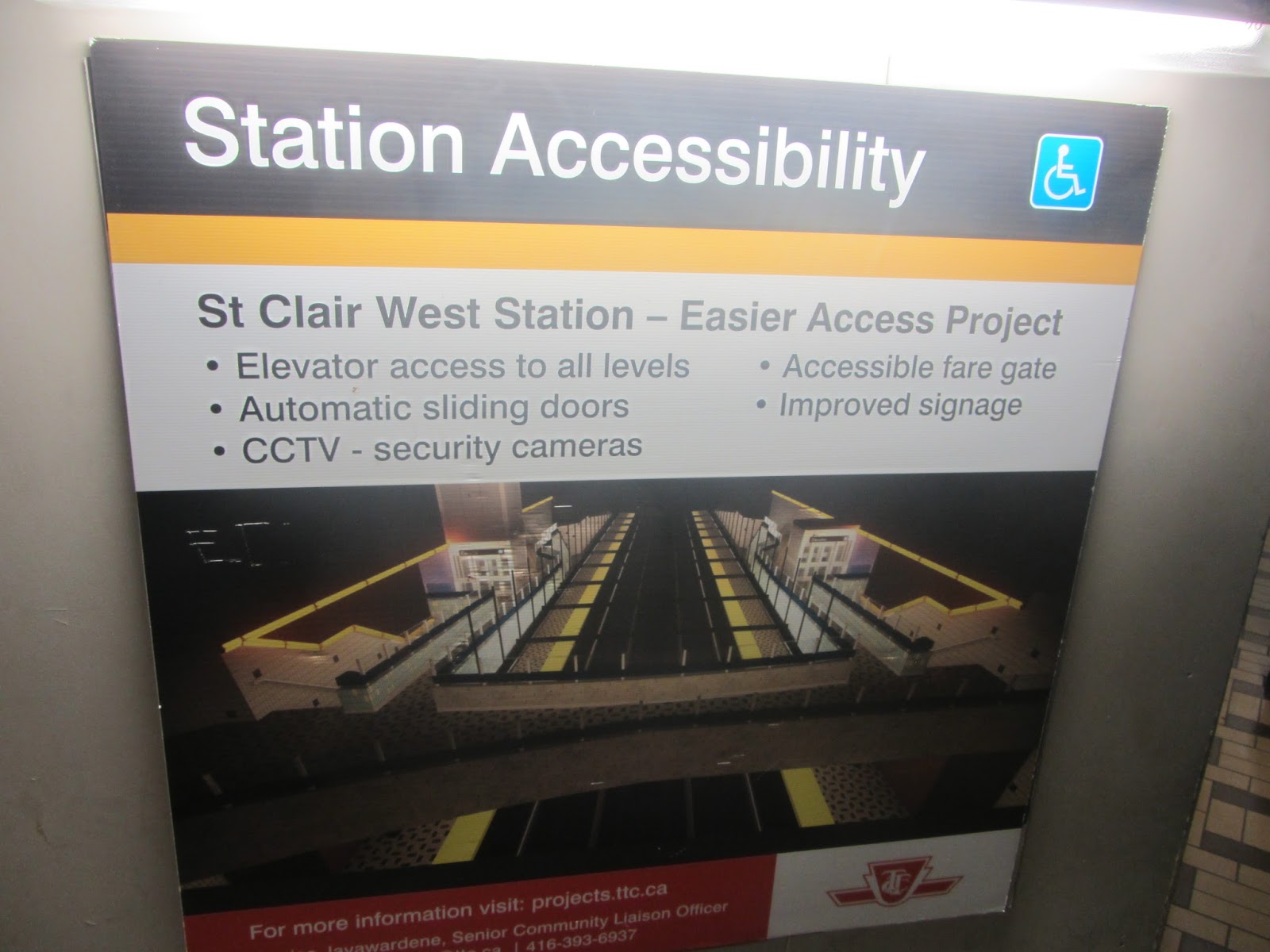
There are signs of investment in the TTC network, which has the impression of a system that may have gone many years without significant expenditure upon it.  ST Clair West is going to be a beneficiary,
More signs of change - which may be influenced by the aforementioned Brits in senior positions at the TTC.....

Interior of the CLRVs does not hide their 1970s design.

Overview of the interior of a CLRV.
Gate line at St Clair West.  Notable that the gates apply to the bus and streetcar stops as well as the escalators down to the subway.  Two things of note: 1. the ticket seller merrily laughing at my activities, and 2. the complete uselessness of the scratch-off day ticket in these gates!


Gratuitous CLRV photo.

And another CLRV.

And another!
Flexity at night.

I don't have enough to review the Subway, but here's an Alexander-Dennis Enviro 400, a product of Falkirk, Scotland, in use as a sightseeing bus in Toronto.  Some 220 more Alexander Dennis double deckers are set to join operations in Ontario.

Thursday, 29 October 2015

Crossing the broken Circle line

Tonight I travelled on a lesser-frequented part of the Underground network, joining the Outer Rail (or Clockwise to the layman) Circle line at Notting Hill Gate.  Despite the S7 Stock trains having been in front line service on the Circle for a good couple of years now, the platform length issues in this area have escaped my recent attention.
Notting Hill Gate Inner Road (anti-clockwise).  The end of the platform is the white barriers on the centre left of the photo, whilst the stop marking for the train is the green and yellow marking to the centre right!  Quite a considerable amount of Circle line and District line (Wimbledon-Edgware Rd service) berths outside the platform.

Notting Hill Gate station. Beautiful, love these cut & roof (rather than cut & cover) stations on the west side of the Circle.  Camera phone does not handle light very well.

On the Outer Rail the tail end of the train, the final two sets of doors, berths outside of the platform. As can be seen the doors of course remain closed.  I assume the same end of the train is used in both directions so the internal stickers, see below, are only at one end.  And I'm writing that trying desperately to think if an S7 could be turned so that the stickers could ever be at the wrong end, and I think that would only be possible is one ended up going round Watford North Curve (post script: this is a ridiculous statement, two minutes more thought and I realise it can easily happen around Cromwell Rd Jn swapping between District and C&H services) - and I think something would have gone seriously wrong for an S7 to end up there!

View from inside the train berthed outside the platform. Move along!

The rear two sets of doors (Outer Rail) - and therefore front two sets on the Inner Rail - have this notice about doors not opening at some stations - the same doors do not open at Bayswater and Paddington (District/Praed St) whilst the sign illuminates in stations.  Talk about bespoke rolling stock!

Heading to King's Cross the cross-platform interchange off the terminating Circle on to the through Circle was almost seamless.  Here's a Hammersmith to Edgware Road train passing through Edgware Road for the first time on its trip.

The S7 in my opinion parallels if not betters the finest metro style rolling stock in the world.  Spacious. clean lines, big doors, walk-through, great customer information.  Work trips with shorter ladies has established a lack of grab rails in some places but far worse exists on the fabled Far Eastern metros!

At Baker Street all three sets of doors in the rear vehicle do not open (this will be the leading three in the opposite direction).  Here's an 'arm-selfie' of what the customer sees through the door!

As an extra set of doors is problematic just at Baker Street, there is a Baker Street-only sign on this set!  There are also visual and audible announcements in this car about doors not opening.  Doesn't stop people trying to get out though!
And I had a quick look at some recent developments on the King's Cross St Pancras London Underground station.....

Memories of 2012:  mass swathes of 'Olympink' have found their way on to the network for the Rugby World Cup. The final is this weekend though so expect to see it come down pretty soon.  The Olympink has become the standard for ad-hoc event signage - it was also used for the Tour de France in 2014. 

However, genuine Olympics signage remains at two lifts (at least, that I saw) at King's Cross St Pancras - they have survived well for 3+ years.  Let's hope they never go!

The new London Underground retail and staffing model has seen many ticket offices close.  The requirement for ticketing capacity at KXSP has seen large new suites of passenger-operated ticket machines installed - the foreground of this picture used to be a conventional ticket office.  I also once spent a spectacularly dull shift assisting at this bank of ticket machines!

The new retail and staffing model has seen 'Visitor Centre' spring up to replace some of the softer functions of the ticket offices.  In bloody pink.  Eurostar trains are still arriving at St Pancras International all of 200 yards from the Visitor Centre: this is the main entrance to the Underground for Eurostar passengers.  It is all brightly lit up and welcoming but is it open? You can guess the answer to that......
Transport for London unwittingly found itself in the press earlier this week, when it installed an automated foreign exchange machine in immediate proximity to the 7/7 Memorial at King's Cross St Pancras.  The photos in the link show it does change the focus from the memorial to the exchange rates.  Well, three days later it has gone. No idea where to.
And here is evidence of it's removal.  The bags by the way were attended just I chose to not include the attendee in shot (and it was a +4 on to my Thameslink train home so I didn't hand around waiting for the bags' owners to move on).


Wednesday, 21 October 2015

Busworld part 2 - electricity

I went to Busworld to look at service buses. Buses for cities.  I have little interest in coaches or inter-urban services, similarly I didn't look at the vast arrays of destination displays, seats, uniforms, lifts, engines, gearboxes, cleaning fluids, oils, and all the other things that make up a bus and coach operation that were seeking buyers.

The overarching theme of the city buses on display was operation by means other than diesel.  Of these electric buses of various sorts were dominant.  This part of the blog will look at just how many different interpretations of electric and systems for charging were on offer.  Again, very little in the way of vehicles designed for the UK - being as they are all left hand drive - but I'll offer some thoughts as I go about applicability to the United Kingdom market.

In order to remember what I'd looked at (without making notes!) I also sought literature from the manufacturers' representatives on their stands.  Some of the stands were very big glossy affairs, some less so.  So were very willing to talk to anyone (especially when you told them you worked for Transport for London!), others less interested in Englishman.  Some had copious leaflets on display, many had [one suspects agency provided] young ladies manning desks behind which literature was hidden, and to some you were their new best friend!

In alphabetical order of manufacturer we start with Bodgan.  Bodgan are a Ukrainian manufacturer who rank as the most friendly, traditionally selling buses domestically and in former USSR, notably Russia and Georgia.  Their reps bemoaned the war with Russia affecting sales, but were proud of the fact they had driven their pretty solid product all the way from Kiev.  I suspect this model A70522 diesel-electric hybrid has no potential in the UK (although it is a Cummins ISB in the back so most British bus engineers will recognise it I think) but could have a 'low cost' appeal in central Europe.  Nice people, good luck to them!

Sileo is a brand that has been developed by Turkish manufacturer Bozankaya, but boy do they keep it quiet.  Everything is branded Sileo, presumably aiming a product at the western European market, which has been a difficult market for the Turks to enter in any real numbers.The Sileo vehicles (rigid and articulated) have roof mounted batteries with a range of 'over' 200km and a 4 hour charge time.  Technology probably isn't quite there for operators who put buses on the road for 20/hours a day.

The first part of this blog showed the BYD electric double decker for London.  BYD's other bus exhibit was this electric 18m articulated bus, which is offered with wither plug-in or pantograph charging.  I hadn't appreciated the pantograph element at the show but there are some other examples of this later!
 
Castrosua of Spain illustrated this 10m hybrid integral bus (they are usually a body builder) utilising Cummins and Siemens technology 'under floor'.  It looks pretty ugly!
Ebusco are a Dutch company who claim to be adapt vehicles from other manufacturers as well as start building their own.  They displayed a 12m fully electric single decker, and claim a 100% charge in 1.6 hours with a 300+km range.  The vehicle on display also carried Transdev fleet names so I assume it will be going on trial with a Trandev operation somewhere soon!

Irizar of Spain brought their i2e plug-in electric bus.  Nothing new here - one has been in service with London Central on the Red Arrow routes 507/521 for a few months now.  Reading about a 6 hour charging time suggests I don't know enough about the different types of battery technology.

Ahhhh King Long.   Forever trying to sell in volume in Europe: the Maltese bought it but otherwise too cheap even for the cheapest of British operators.  I'm not sure many UK operators will touch King Long after the issues with their previous UK agents.  Somewhat dismissive salesman, who insists they will be in the UK next year.  Nice pen and USB set from them though1  This King Long E12 is a combined plug-in and diesel-hybrid electric bus featuring a Cummins engine. 

King Long E12. How many buttons? This is the left side of the dash.  I love the diagrams on the top row.

More buttons, this is the right side of the dash.

More buttons here than on an entire Dart!  This is the side of the cab below the window.  I forgot to photograph the steering wheel, which the King Long brochure shows with an additional 12 buttons.

And two buttons worth focussing on.  Snow might be useful.  But, what single decker service bus needs a 'sport' button??
Citywide is the branding for Scania's range of Citybuses.  The LE features a chonking great 9 litre engine and a fuel capacity of 300-400 litres.  In my mind tht suggests it should run for days and days without refuelling, though the publicity is scant on detail about the eletric bits, and seems to rely a lot on bio-fuels.  Suspect they are playing catch-up and prefer to be building nice heavyweight diesel city buses!

A Solaris pure electric bus: pantograph charging is just visible.  Probably the snobbiest stand! I've no idea what this is called, and although I'm assured they will never be sold in the UK, they have gone a but 'Borismaster' with the windscreen!

But what a cab!  Or, spaceship mission control :-) I think that would do my nut driving at night and I'd prefer a nice set of rocker switches.

The Solaris electric bus also featured a simulator. Clearly for children, but I didn't crash in my brief play!

The VDL Citea Electric offers a choice of electric hub motors or an electric driveline alongside a 4.5L Cummins diesel engine on a rigid or articulated chassis. I wonder if the electrics will make it to the UK with Arriva?

The VDL Citea Electric also offers a pantograph charging option.

Volvo also offer pantograph charging in their 7900 battery bus.

Volvo also offer a diesel-electric hybrid version of their 7900m shown here in articulated form.

The last electric is the Yutong E12.  Yutong are apparently the world's biggest bus manufacturer, and this left hand drive diesel/battery hybrid is for trial service in Paris.  Of every Chinese bus I have been in this felt the most western, solid feeling interior, cab without a million buttons or blind strings and relatively modest looks.  Yep the UK salesman is from Yorkshire and a right hand drive version is on the cards......