Wednesday, 21 October 2015

Busworld part 2 - electricity

I went to Busworld to look at service buses. Buses for cities.  I have little interest in coaches or inter-urban services, similarly I didn't look at the vast arrays of destination displays, seats, uniforms, lifts, engines, gearboxes, cleaning fluids, oils, and all the other things that make up a bus and coach operation that were seeking buyers.

The overarching theme of the city buses on display was operation by means other than diesel.  Of these electric buses of various sorts were dominant.  This part of the blog will look at just how many different interpretations of electric and systems for charging were on offer.  Again, very little in the way of vehicles designed for the UK - being as they are all left hand drive - but I'll offer some thoughts as I go about applicability to the United Kingdom market.

In order to remember what I'd looked at (without making notes!) I also sought literature from the manufacturers' representatives on their stands.  Some of the stands were very big glossy affairs, some less so.  So were very willing to talk to anyone (especially when you told them you worked for Transport for London!), others less interested in Englishman.  Some had copious leaflets on display, many had [one suspects agency provided] young ladies manning desks behind which literature was hidden, and to some you were their new best friend!

In alphabetical order of manufacturer we start with Bodgan.  Bodgan are a Ukrainian manufacturer who rank as the most friendly, traditionally selling buses domestically and in former USSR, notably Russia and Georgia.  Their reps bemoaned the war with Russia affecting sales, but were proud of the fact they had driven their pretty solid product all the way from Kiev.  I suspect this model A70522 diesel-electric hybrid has no potential in the UK (although it is a Cummins ISB in the back so most British bus engineers will recognise it I think) but could have a 'low cost' appeal in central Europe.  Nice people, good luck to them!

Sileo is a brand that has been developed by Turkish manufacturer Bozankaya, but boy do they keep it quiet.  Everything is branded Sileo, presumably aiming a product at the western European market, which has been a difficult market for the Turks to enter in any real numbers.The Sileo vehicles (rigid and articulated) have roof mounted batteries with a range of 'over' 200km and a 4 hour charge time.  Technology probably isn't quite there for operators who put buses on the road for 20/hours a day.

The first part of this blog showed the BYD electric double decker for London.  BYD's other bus exhibit was this electric 18m articulated bus, which is offered with wither plug-in or pantograph charging.  I hadn't appreciated the pantograph element at the show but there are some other examples of this later!
 
Castrosua of Spain illustrated this 10m hybrid integral bus (they are usually a body builder) utilising Cummins and Siemens technology 'under floor'.  It looks pretty ugly!
Ebusco are a Dutch company who claim to be adapt vehicles from other manufacturers as well as start building their own.  They displayed a 12m fully electric single decker, and claim a 100% charge in 1.6 hours with a 300+km range.  The vehicle on display also carried Transdev fleet names so I assume it will be going on trial with a Trandev operation somewhere soon!

Irizar of Spain brought their i2e plug-in electric bus.  Nothing new here - one has been in service with London Central on the Red Arrow routes 507/521 for a few months now.  Reading about a 6 hour charging time suggests I don't know enough about the different types of battery technology.

Ahhhh King Long.   Forever trying to sell in volume in Europe: the Maltese bought it but otherwise too cheap even for the cheapest of British operators.  I'm not sure many UK operators will touch King Long after the issues with their previous UK agents.  Somewhat dismissive salesman, who insists they will be in the UK next year.  Nice pen and USB set from them though1  This King Long E12 is a combined plug-in and diesel-hybrid electric bus featuring a Cummins engine. 

King Long E12. How many buttons? This is the left side of the dash.  I love the diagrams on the top row.

More buttons, this is the right side of the dash.

More buttons here than on an entire Dart!  This is the side of the cab below the window.  I forgot to photograph the steering wheel, which the King Long brochure shows with an additional 12 buttons.

And two buttons worth focussing on.  Snow might be useful.  But, what single decker service bus needs a 'sport' button??
Citywide is the branding for Scania's range of Citybuses.  The LE features a chonking great 9 litre engine and a fuel capacity of 300-400 litres.  In my mind tht suggests it should run for days and days without refuelling, though the publicity is scant on detail about the eletric bits, and seems to rely a lot on bio-fuels.  Suspect they are playing catch-up and prefer to be building nice heavyweight diesel city buses!

A Solaris pure electric bus: pantograph charging is just visible.  Probably the snobbiest stand! I've no idea what this is called, and although I'm assured they will never be sold in the UK, they have gone a but 'Borismaster' with the windscreen!

But what a cab!  Or, spaceship mission control :-) I think that would do my nut driving at night and I'd prefer a nice set of rocker switches.

The Solaris electric bus also featured a simulator. Clearly for children, but I didn't crash in my brief play!

The VDL Citea Electric offers a choice of electric hub motors or an electric driveline alongside a 4.5L Cummins diesel engine on a rigid or articulated chassis. I wonder if the electrics will make it to the UK with Arriva?

The VDL Citea Electric also offers a pantograph charging option.

Volvo also offer pantograph charging in their 7900 battery bus.

Volvo also offer a diesel-electric hybrid version of their 7900m shown here in articulated form.

The last electric is the Yutong E12.  Yutong are apparently the world's biggest bus manufacturer, and this left hand drive diesel/battery hybrid is for trial service in Paris.  Of every Chinese bus I have been in this felt the most western, solid feeling interior, cab without a million buttons or blind strings and relatively modest looks.  Yep the UK salesman is from Yorkshire and a right hand drive version is on the cards......


Tuesday, 20 October 2015

Athens Metro and the Economic Meltdown

July 2015 took me to down town Athens for the first time.  In the aftermath of financial meltdown and a never ending round of elections, who knew what I'd find?

I started with the train service (operated by Trainosem, Greek national railways) from the new international airport, to connect to the Metro Line 1 at Nerantziotissa.  The service winds it way round northern Athens every 20-30 minutes, and shares track with the half hourly service on Metro line 3 as far as Douk.Plekantias.  This was the most convenient route for my hotel, but as becanme evident not the way many tourists go or are advised to go.

There is a staffed ticket office at Athens airport.  There is basically only one ticket, which at 8 euros is a significant fare premium  to get to/from the airport (usual single fare is 1.20 euros).

Map of Athens Metro also showing the Trainose heavy rail line, in yellow.  Borrowed from Wikipedia.

Rolling stock used on the Trainose service from the airport looks decent - from a distance.  Memory escapes me as to what it was other than definitely being German!

Up close it is a lot rougher, lots of evidence of graffiti removal.


The Trainose Athens-Kiato railway from the airport is running in the median of the motorway network for much of its length.
Interchange to Metro Line 1 (dating from 1860s) is at Nerantziotissa.  There are separate ticket offices for the main line railway and the Metro - or were.  This is the main line ticket office now closed and plastered in notices of various sorts.

The whole station at Narantziotissa has a very unkept feel.  Here some ticket validators are missing on entry to the southbound metro platform.

A whiteboard serving no use whatsoever!

Rolling stock on Line 1 dates from the 1980s and 1990s and is in very poor visual condition.

Interiors and particularly windows on line 1 have a lot of graffiti.

Bodysides of line 1 trains are also heavily graffitied.


The station at Larissa is nicely decorated on several walls with images of Greek railways of days gone by.

Quite a simple range of tickets for travel outside of the airport premium. 60 cents child single, 1.20 euros adult single or a 4 euro day ticket.  With the option of buying up to 5 tickets.  Normally I'd admonish for such a poor range but at such low fares it seems entirely appropriate to be simple.  There are also weekly and longer season tickets availabke which i assume you'd need to use a ticket office for.

Not all Athens Metro stations are graffitied and grotty: this is Syntagma in central Athens.

Athens Metro lines 2 and 3 operate independantly from line 1, with different signalling systems and rolling stock.  Whilst some older style rolling stock. similar to line 1, is used, the majority of line 2 and 3 trains are modern smart units built by Hyundai-Rotem.

A different (older, early 2000s) style of Hyundai-Rotem train for Athens Metro lines 2 and 3.

The newest line 2/3 cars have illuminated car line diagrams showing the next stop.
  
The car line diagrams extenuate the fact that different stock operates on lines 2 and 3.  Note also the use of the Olympic rings on the tube map: I assume they have an exemption to do this as they are very closely protected trademark!

The usual interchange station for airport customers using the Trainosel service is at Douk. Plekantias, where you change from line 3 (not withstanding the half hourly through service on line 3 to the airport!).  As can be seen it is much more modern and welcoming at concourse level.

The waiting environment for the Trainose service is just as grim as everywhere else: a concrete box surrounded by motorway!
My visit was at the height of the Greek financial crisis.  However here is a cash machine with no queue, proving what the TV news reports show - long queues etc - is not reflected in reality.

Another ATM with no queue. Loadsamoney!

Pro- and anti- osterity protests outside parliament at Syntagma Square.

Graffiti though is everywhere in Athens!


Busworld part 1 - getting there & the electric double decker

So followin my dramas in Rotterdam the night before, my reason for the in the Benelux was to attend Busworld in Kortrijk's exhibition centre, Xpo.  Busworld is a bus and coach industry trade show aimed primarily at continental European and near-Asian operations.  British operatioons tend to rely on domestically built buses and there are separate shows for the UK market (Euro Bus Expo and Coach & Bus Live in the NEC, Birmingham), whilst the French also have an annual show (mainly school buses and odd ball minibuses) called Transports Publiques, held in Paris.

A note about getting to Kortrijk part 1: everyone in the UK knows that foreign railways are always more reliable [sic, they're not].  Here's Nederlands Spoorwegen reminding us they own Abellio!

A note about getting to Kortrijk part 2: the bus service from the station to the Xpo Centre (routes 1/2/13) stops on the main road.  There is no footpath in to the Xpo North Entrance!  Just a wall and a lake!
The purpose of this blog post is to look at the buses and technologies on display.  It comes with a health warning that I might have ignored things (e.g. Turkish buses) and I might be overly enthusiastic just because I found a native English speaker on certain stands!

So, having started by saying this is all about continental European buses, welcoming people at the Xpo North Entrance was the Build Your Dreams (BYD) fully plug-in electric double decker prototype, resplendent in London red and shortly to be delivered to Metroline at Willesden bus garage. Worthy of a little look, I thought.......


Overview of the vehicle, already adorned with all the fleetnames and lettering it needs for London.  It will be fleet number BYD1471 with Metroline, which seems a little out of sequence as Metroline are currently in the low 2000s with new deliveries.

Ugly  - looks a bit like the Duple Metsec double deckers in Hong Kong.  It was just badged as a BYD E-Bus but I understand it's proper type designation is a B8SR

Not many seats down stairs.  Three rows of seats up to the rear/  The rear seats are on the rear wheel arch so no rear facing seats: the whole rear overhand downstairs is taken up with the battery pack.

Upstairs there is an amazing amount of legroom.  I assume the lack of seats (and thus capacity, remember no standing allowed on the upper deck) is to keep the weight down.

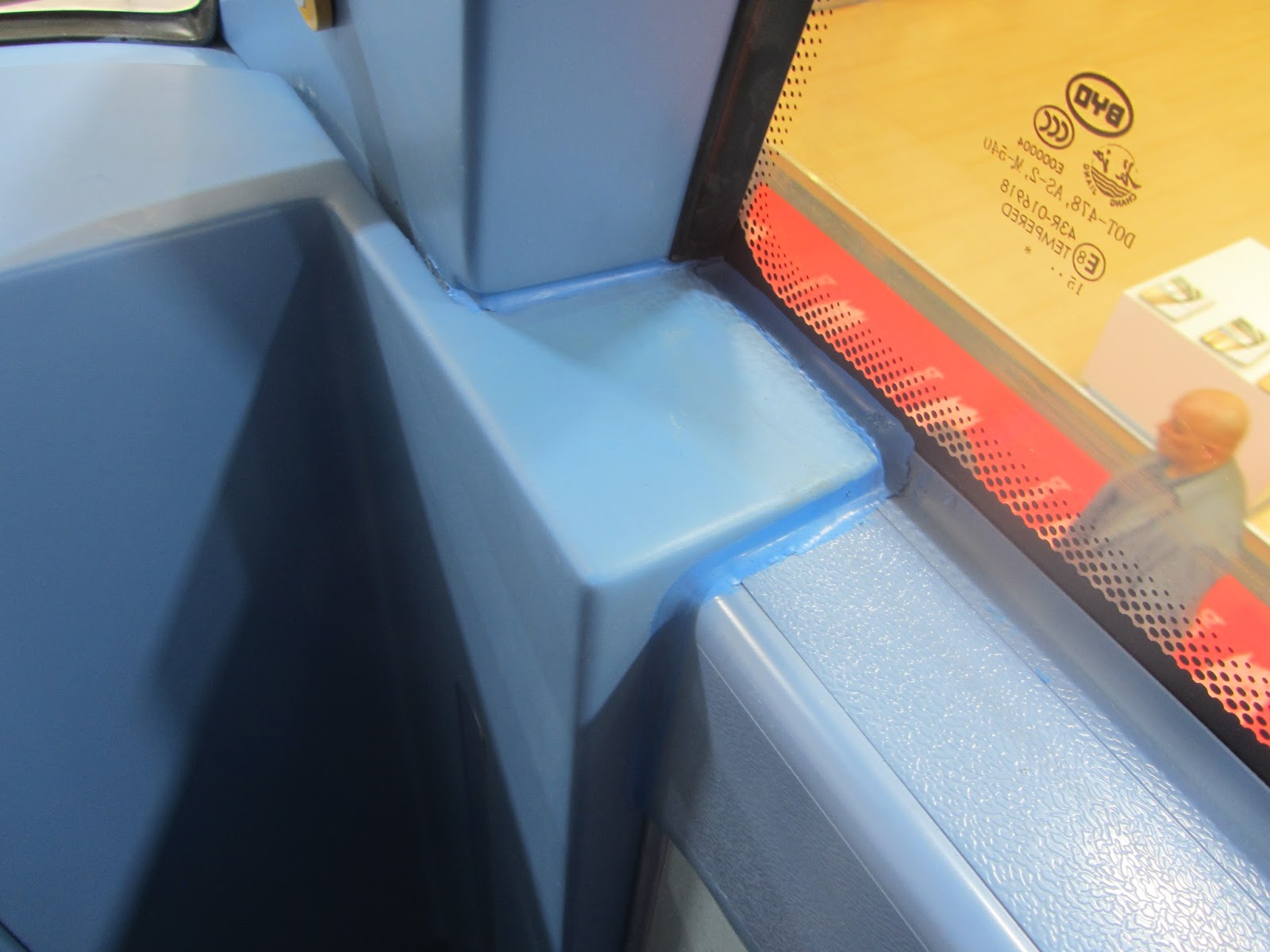
None of the internal access panels are locked.  All four clips were opened and the panel removed.

Somewhat bodged together internal panelling.

External panels are all locked, including the bonnet.  All locks are covered by rather flimsy covers that the garage fitters will have off within a week!
It must be remembered this bus is a proof-of-concept - cum - prototype.  The BYD staff on the stand are very proud of the vehicle: indeed Chinese ambition is to sell vehicles in Europe and the UK and it is indeed very prestigious that Transport for London have chosen to take on this vehicle, and presumably pay a reasonable whack for it.  However in common with my experience of Chinese buses the build quality is very poor: I felt the internal panels could be removed by hand.  Combined with the interior access panels all being open access, I am not sure it will last long on the mean streets of Cricklewood: at the very least Metroline will need to be bringing it home at dusk.  It also has a very low capacity compared to a regular double deker - 54 seated compared to 61-67 on Enviro 400s) so may not be best used on a regular duty in the peaks.  Rather I can see this tottering around an an 'extra' in the interpeak until the wrinkles are worked out. With BYD  joining forces with ADL for the Red Arrow fleet, I do wonder how long it will be before see the the battery pack under an Enviro 400.....now that will be interesting!!


OV Chipkaart: perils for the logical!

On Friday evening, 16 October, I had cause to get from Rotterdam's airport to the city centre,  The airport's advice was to use the bus no. 33 for the short trip to the nearby RandstandRail line E at Meijersplein. 

Outside the terminal is a sheltered facility with two ticket machines, and translation in to English, as well as a few other languages, available.  There were two practical ticket options, either the 'return' ticket, at 6 euros, valid for an hour today to get in to the city, and an hour at some day in the future to get back, or a 2-hour ticket at 3.50 euros.  Whilst the publicity heavily promoted the former, I chose the latter, to enable a convoluted journey if I so chose.

 OV Chipkaart is the Dutch national public transport ticketing system, in it's most basic form is a stored value card which deducts fares as you travel.


Can't fault the travel advice!

The ticket machine.  With translations in to German, French and English available, it couldn't be simpler.  It offers a top up to a Chipkaart, or the opportunity to buy a single use Chipkaart (aka a ticket) for immediate travel.


To travel, there is a 'touch in' reader on the bus, in this case a Mercedes Citaro operated by the municipal undertaking, RET.

Not many people on this bus!  Even in the evening it runs every 15 minutes between Rotterdam city centre and Meijersplein via the airport

 The bus stops at a single bus stop immediately outside the station at Meijersplein.  Simple, go in to the station and catch the train.  Or is it?  My 3.50 Euro ticket wouldn't work the gates.  Using a bit of Underground logic, I tried forcing them (as you do!).  They wouldn't budge.  The easy solution was to buy another ticket: there was a ticket machine in the corner. 

Meijersplein station.  Of typical modern glass box design.

The bus stop at Meijersplein station.

Simple technology, even a non-Dutch speaker could interpret "kaart hier"!

However when I placed my card on, I got a red light and what presumably translates as "kaart was not touched out on the previous bus you got off so I don't know that you're here so go away and hang your head in shame, jolly foreigner!"   
 So it turns out that even on a fixed fare, fixed time ticket, where 'checking out' would make absolutely no different to the fare paid or the validity of the ticket, it is still necessary.  And people call Oyster complicated!

Usefully the ticket machine at Meijersplein also offered English, German and French.  However none of the language buttons actually worked, whilst in Dutch it would not sell a single use Chipkaart: presumably along with taxes and death, ownership of a Chipkaart is a compulsory part of being Dutch!
 
In my despair I tried to 'check out' on the next no. 33 bus.  That didn't work, but I did notice what appears to be some form of under-vehicle charging facility at the bus stop.  Absolutely no idea if this is for the Citaros I saw on the 33 or not.


Meijersplein station is completely unstaffed.  So for, I think, the first time in my life I took a punt on the 'SOS' button.  I figured the presence of an emergency button below, with a note about a fine for improper use meant that that 'SOS' meant 'customer help'.  The button got through to a control room, and although I don't speak Dutch, the Dutch genrrally speak better English than most Brits so were able to remotely open a gate and let me in.


Overview of Meijersplein at platform level.  Clean, fairly modern, but short canopies not conducive to "using the full length of the platform" - though this hardy northerner didn't mind a spot of rain to bring you this picture!
 
The next challenge was getting out of the system at Rotterdam Centraal.  Needless to say, I got the same red light and "silly boy why didn't you check out of the bus" message. Pressed the SOS button again, and I believe the same voice answered, promising to send someone. Someone came, played with my ticket, and told me it was worthless.

The people in this office on the concourse at Rotterdam Centraal Metro station cannot help you.  They are for information only.  Nothing useful like resetting the ticket of a jolly foreigner who didn't 'check out' of a bus an hour ago.


So. Chipkaart. Awesome idea. Unnecessarily complicated. In fact, one could say unnecessary altogether, and the back end systems could be retained with 'wave and pay' technology deducting fares direct from a bank account or credit card.  I miss the old Strippenkaarten, not so sure I'll miss OV Chipkaart!