Tuesday, 20 October 2015

Athens Metro and the Economic Meltdown

July 2015 took me to down town Athens for the first time.  In the aftermath of financial meltdown and a never ending round of elections, who knew what I'd find?

I started with the train service (operated by Trainosem, Greek national railways) from the new international airport, to connect to the Metro Line 1 at Nerantziotissa.  The service winds it way round northern Athens every 20-30 minutes, and shares track with the half hourly service on Metro line 3 as far as Douk.Plekantias.  This was the most convenient route for my hotel, but as becanme evident not the way many tourists go or are advised to go.

There is a staffed ticket office at Athens airport.  There is basically only one ticket, which at 8 euros is a significant fare premium  to get to/from the airport (usual single fare is 1.20 euros).

Map of Athens Metro also showing the Trainose heavy rail line, in yellow.  Borrowed from Wikipedia.

Rolling stock used on the Trainose service from the airport looks decent - from a distance.  Memory escapes me as to what it was other than definitely being German!

Up close it is a lot rougher, lots of evidence of graffiti removal.


The Trainose Athens-Kiato railway from the airport is running in the median of the motorway network for much of its length.
Interchange to Metro Line 1 (dating from 1860s) is at Nerantziotissa.  There are separate ticket offices for the main line railway and the Metro - or were.  This is the main line ticket office now closed and plastered in notices of various sorts.

The whole station at Narantziotissa has a very unkept feel.  Here some ticket validators are missing on entry to the southbound metro platform.

A whiteboard serving no use whatsoever!

Rolling stock on Line 1 dates from the 1980s and 1990s and is in very poor visual condition.

Interiors and particularly windows on line 1 have a lot of graffiti.

Bodysides of line 1 trains are also heavily graffitied.


The station at Larissa is nicely decorated on several walls with images of Greek railways of days gone by.

Quite a simple range of tickets for travel outside of the airport premium. 60 cents child single, 1.20 euros adult single or a 4 euro day ticket.  With the option of buying up to 5 tickets.  Normally I'd admonish for such a poor range but at such low fares it seems entirely appropriate to be simple.  There are also weekly and longer season tickets availabke which i assume you'd need to use a ticket office for.

Not all Athens Metro stations are graffitied and grotty: this is Syntagma in central Athens.

Athens Metro lines 2 and 3 operate independantly from line 1, with different signalling systems and rolling stock.  Whilst some older style rolling stock. similar to line 1, is used, the majority of line 2 and 3 trains are modern smart units built by Hyundai-Rotem.

A different (older, early 2000s) style of Hyundai-Rotem train for Athens Metro lines 2 and 3.

The newest line 2/3 cars have illuminated car line diagrams showing the next stop.
  
The car line diagrams extenuate the fact that different stock operates on lines 2 and 3.  Note also the use of the Olympic rings on the tube map: I assume they have an exemption to do this as they are very closely protected trademark!

The usual interchange station for airport customers using the Trainosel service is at Douk. Plekantias, where you change from line 3 (not withstanding the half hourly through service on line 3 to the airport!).  As can be seen it is much more modern and welcoming at concourse level.

The waiting environment for the Trainose service is just as grim as everywhere else: a concrete box surrounded by motorway!
My visit was at the height of the Greek financial crisis.  However here is a cash machine with no queue, proving what the TV news reports show - long queues etc - is not reflected in reality.

Another ATM with no queue. Loadsamoney!

Pro- and anti- osterity protests outside parliament at Syntagma Square.

Graffiti though is everywhere in Athens!


Busworld part 1 - getting there & the electric double decker

So followin my dramas in Rotterdam the night before, my reason for the in the Benelux was to attend Busworld in Kortrijk's exhibition centre, Xpo.  Busworld is a bus and coach industry trade show aimed primarily at continental European and near-Asian operations.  British operatioons tend to rely on domestically built buses and there are separate shows for the UK market (Euro Bus Expo and Coach & Bus Live in the NEC, Birmingham), whilst the French also have an annual show (mainly school buses and odd ball minibuses) called Transports Publiques, held in Paris.

A note about getting to Kortrijk part 1: everyone in the UK knows that foreign railways are always more reliable [sic, they're not].  Here's Nederlands Spoorwegen reminding us they own Abellio!

A note about getting to Kortrijk part 2: the bus service from the station to the Xpo Centre (routes 1/2/13) stops on the main road.  There is no footpath in to the Xpo North Entrance!  Just a wall and a lake!
The purpose of this blog post is to look at the buses and technologies on display.  It comes with a health warning that I might have ignored things (e.g. Turkish buses) and I might be overly enthusiastic just because I found a native English speaker on certain stands!

So, having started by saying this is all about continental European buses, welcoming people at the Xpo North Entrance was the Build Your Dreams (BYD) fully plug-in electric double decker prototype, resplendent in London red and shortly to be delivered to Metroline at Willesden bus garage. Worthy of a little look, I thought.......


Overview of the vehicle, already adorned with all the fleetnames and lettering it needs for London.  It will be fleet number BYD1471 with Metroline, which seems a little out of sequence as Metroline are currently in the low 2000s with new deliveries.

Ugly  - looks a bit like the Duple Metsec double deckers in Hong Kong.  It was just badged as a BYD E-Bus but I understand it's proper type designation is a B8SR

Not many seats down stairs.  Three rows of seats up to the rear/  The rear seats are on the rear wheel arch so no rear facing seats: the whole rear overhand downstairs is taken up with the battery pack.

Upstairs there is an amazing amount of legroom.  I assume the lack of seats (and thus capacity, remember no standing allowed on the upper deck) is to keep the weight down.

None of the internal access panels are locked.  All four clips were opened and the panel removed.

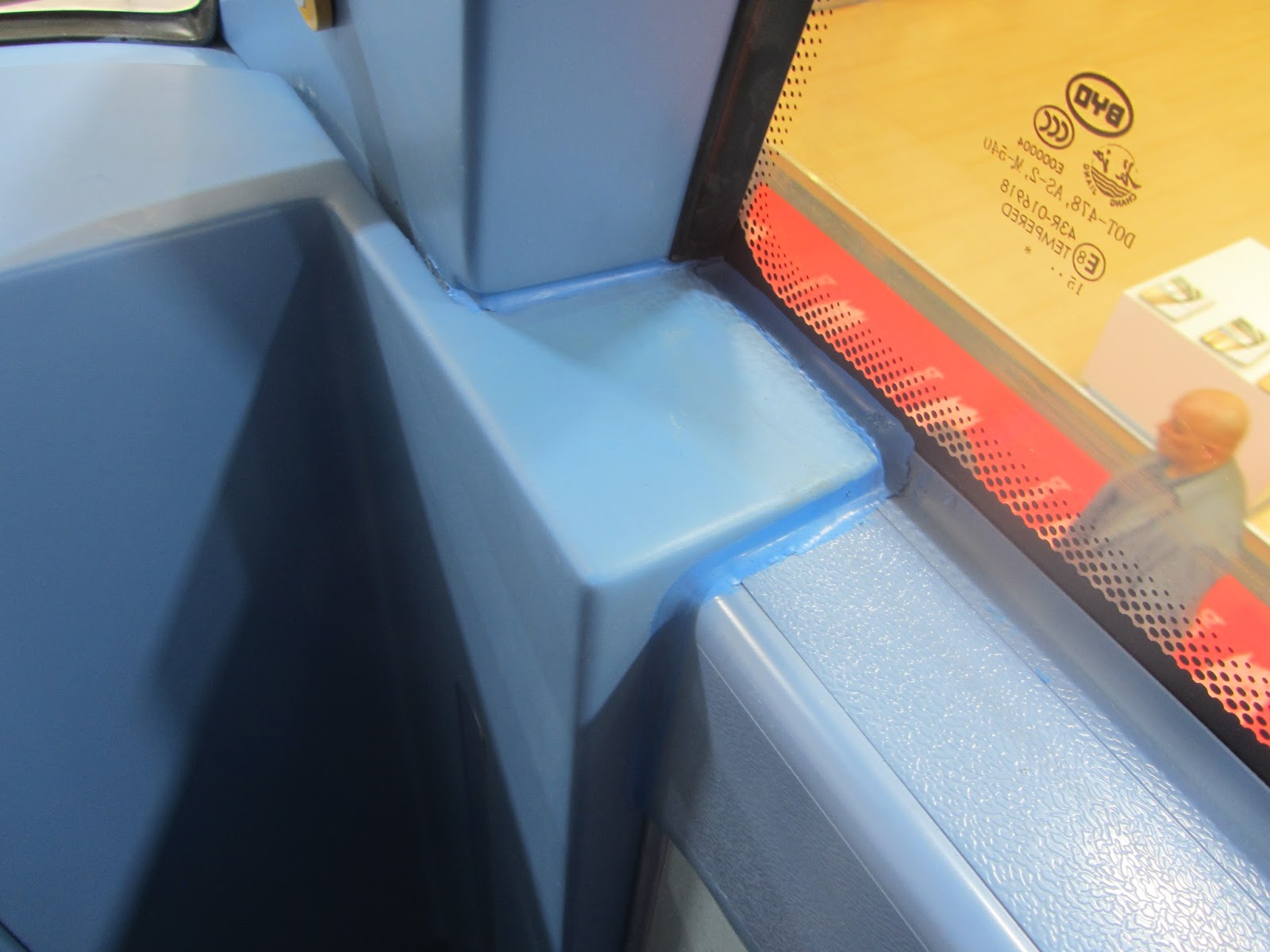
Somewhat bodged together internal panelling.

External panels are all locked, including the bonnet.  All locks are covered by rather flimsy covers that the garage fitters will have off within a week!
It must be remembered this bus is a proof-of-concept - cum - prototype.  The BYD staff on the stand are very proud of the vehicle: indeed Chinese ambition is to sell vehicles in Europe and the UK and it is indeed very prestigious that Transport for London have chosen to take on this vehicle, and presumably pay a reasonable whack for it.  However in common with my experience of Chinese buses the build quality is very poor: I felt the internal panels could be removed by hand.  Combined with the interior access panels all being open access, I am not sure it will last long on the mean streets of Cricklewood: at the very least Metroline will need to be bringing it home at dusk.  It also has a very low capacity compared to a regular double deker - 54 seated compared to 61-67 on Enviro 400s) so may not be best used on a regular duty in the peaks.  Rather I can see this tottering around an an 'extra' in the interpeak until the wrinkles are worked out. With BYD  joining forces with ADL for the Red Arrow fleet, I do wonder how long it will be before see the the battery pack under an Enviro 400.....now that will be interesting!!


OV Chipkaart: perils for the logical!

On Friday evening, 16 October, I had cause to get from Rotterdam's airport to the city centre,  The airport's advice was to use the bus no. 33 for the short trip to the nearby RandstandRail line E at Meijersplein. 

Outside the terminal is a sheltered facility with two ticket machines, and translation in to English, as well as a few other languages, available.  There were two practical ticket options, either the 'return' ticket, at 6 euros, valid for an hour today to get in to the city, and an hour at some day in the future to get back, or a 2-hour ticket at 3.50 euros.  Whilst the publicity heavily promoted the former, I chose the latter, to enable a convoluted journey if I so chose.

 OV Chipkaart is the Dutch national public transport ticketing system, in it's most basic form is a stored value card which deducts fares as you travel.


Can't fault the travel advice!

The ticket machine.  With translations in to German, French and English available, it couldn't be simpler.  It offers a top up to a Chipkaart, or the opportunity to buy a single use Chipkaart (aka a ticket) for immediate travel.


To travel, there is a 'touch in' reader on the bus, in this case a Mercedes Citaro operated by the municipal undertaking, RET.

Not many people on this bus!  Even in the evening it runs every 15 minutes between Rotterdam city centre and Meijersplein via the airport

 The bus stops at a single bus stop immediately outside the station at Meijersplein.  Simple, go in to the station and catch the train.  Or is it?  My 3.50 Euro ticket wouldn't work the gates.  Using a bit of Underground logic, I tried forcing them (as you do!).  They wouldn't budge.  The easy solution was to buy another ticket: there was a ticket machine in the corner. 

Meijersplein station.  Of typical modern glass box design.

The bus stop at Meijersplein station.

Simple technology, even a non-Dutch speaker could interpret "kaart hier"!

However when I placed my card on, I got a red light and what presumably translates as "kaart was not touched out on the previous bus you got off so I don't know that you're here so go away and hang your head in shame, jolly foreigner!"   
 So it turns out that even on a fixed fare, fixed time ticket, where 'checking out' would make absolutely no different to the fare paid or the validity of the ticket, it is still necessary.  And people call Oyster complicated!

Usefully the ticket machine at Meijersplein also offered English, German and French.  However none of the language buttons actually worked, whilst in Dutch it would not sell a single use Chipkaart: presumably along with taxes and death, ownership of a Chipkaart is a compulsory part of being Dutch!
 
In my despair I tried to 'check out' on the next no. 33 bus.  That didn't work, but I did notice what appears to be some form of under-vehicle charging facility at the bus stop.  Absolutely no idea if this is for the Citaros I saw on the 33 or not.


Meijersplein station is completely unstaffed.  So for, I think, the first time in my life I took a punt on the 'SOS' button.  I figured the presence of an emergency button below, with a note about a fine for improper use meant that that 'SOS' meant 'customer help'.  The button got through to a control room, and although I don't speak Dutch, the Dutch genrrally speak better English than most Brits so were able to remotely open a gate and let me in.


Overview of Meijersplein at platform level.  Clean, fairly modern, but short canopies not conducive to "using the full length of the platform" - though this hardy northerner didn't mind a spot of rain to bring you this picture!
 
The next challenge was getting out of the system at Rotterdam Centraal.  Needless to say, I got the same red light and "silly boy why didn't you check out of the bus" message. Pressed the SOS button again, and I believe the same voice answered, promising to send someone. Someone came, played with my ticket, and told me it was worthless.

The people in this office on the concourse at Rotterdam Centraal Metro station cannot help you.  They are for information only.  Nothing useful like resetting the ticket of a jolly foreigner who didn't 'check out' of a bus an hour ago.


So. Chipkaart. Awesome idea. Unnecessarily complicated. In fact, one could say unnecessary altogether, and the back end systems could be retained with 'wave and pay' technology deducting fares direct from a bank account or credit card.  I miss the old Strippenkaarten, not so sure I'll miss OV Chipkaart!


Wednesday, 3 June 2015

Underground Film Club

As everyone knows (or certainly anyone who's had the misfortune to engage me in conversation over the last 18 months knows) , London Underground launches weekend 24-hour operations over the weekend of September 12/13, 2015.  The Communications people in TfL know no bounds when it comes to publicity events, so in conjunction with the Rooftop Film Club they have arranged a series of 'Underground Film Club' events, featuring movies which are largely set in London using the disused Jubilee line concourse at Charing Cross station.  So when someone asks "do you want to watch a movie in a disused Tube station?" the only logical answer is yes.  Especially when a hot dog and pop corn is part of the deal!


The Underground Film Club Box Office - in the passageway adjacent to Charing Cross Underground station.  I think this is actually Westminster City Council owned land.  These people like having their photo taken.

The black card equals a hot dog, the red one popcorn & delicious non-alcoholic drink (this is TfL where open containers of alcohol or consumption of alcohol is prohibited....).  The is the escalator bank from the Strand/Northern line side of the station to platforms.
Entry only by special wristband!

Every Escalator Matters!  This is the escalator bank that is usually hidden behind an anonymous door as you make your way to the Northern line.  The central escalator actually works - this area hasn't seen customers for 16 years!
 
Signage as was when the station closed.

Cinema set up with canvas 'directors' chairs.  Sound is wirelessly broadcast to headphones!

Film in motion, little LEDs on everyone's headphones visible....

More 'as you were' signage, when the Jubilee line ran from Charing Cross to Stanmore and DLR was the only railway to Canary Wharf.  Twenty years later it will gain Crossrail service.
 
The unanswered question is 'what was the movie?'.  Well a wide variety of films are being shown, and I saw 'Paddington'. It is a delightful story of how Paddington Bear got from deepest Peru to my childhood bedroom - sorry - London, and how he first developed his taste for marmalade!  Which leaves me to advise that is you get the chance, go to the Underground Film Club, it is truly an awesome use of this space, right in the centre of the West End.  And the hot dogs were very very nice!

Sunday, 31 May 2015

Crossrail Day One

For the last few years London's new railway 'Crossrail' has been creating massive construction sites across London and the home counties, not least in some prime Zone 1 land around Paddington, Tottenham Court Road and Liverpool Street, but ranging from the reconstruction of Reading junction, marking the northern extension of the Canary Wharf complex, to forcing the relocation of Pudding Mill Lane station on the Docklands Light Railway and reshaping the landscape along East Silvertown.  Underground, eight ladies have been digging away for the last four years creating the tunnels that will eventually house the cross-London metro service.  Sunday 31 May 2015 marks another significant step in the delivery of the Crossrail service: whilst the full service between Shenfield/Abbey Wood and Reading will not be operational until 2019, the first of the constituent parts passed to Transport for London control and it's chosen concessionaire, MTR Corporation (Crossrail) Ltd.  The first section of line operated by MTR Crossrail is the all stations service between London Liverpool Street and Shenfield, the latter just in Essex, previously under the control of the Abellio Greater Anglia franchise. I went to see what was happening on day one......

 
Works continues apace building Crossrail.  This is Farringdon on Sunday 31 May: unlike people who dig up roads, the railways keep working and pouring cement seven days a week.

Construction continues apace, this is the eastern tunnel portal just west of Stratford station, as viewed from the eastbound Docklands Light Railway platform at Pudding Mill Lane.

Initially the Crossrail concessionaire will operate services branded as TfL Rail.  Some limited signage bearing this brand is in place adjacent to the high numbered platforms at Liverpool Street, where the Shenfield services depart from.


Departures information at Liverpool Street correctly listed the services to Gidea Park or Shenfield as TfL Rail.   Now I don't like to praise Network Rail but......

The National Rail timetable change date was two weeks ago, Sunday 17 May 2015. On this day temporary timetables were produced which do not bear any operator branding.  The TfL Rail Shenfield line booklet also contains the timetable for the Romford to Upminster service, which has passed to London Overground but is remote from any other Overground operations. (And yes I have tried putting it the right way round but Blogger insists on importing it sideways)

 
Most of the MTR Crossrail/TfL Rail fleet of Class 315s is in this base white livery with red doors, carrying no fleetnames.

Some of the MTR Crossrail fleet of Class 315s have been outshopped in this base white livery with blue doors and lower bodyside.  This is akin to the basic colours carried by some of TfLs other rail operations: Underground, Overground and Tramlink.  I assume that over the next few months the rest of the MTR Crossrail fleet will be modified with this livery, and roundels added to the bodysides.

Immediately after taking this photograph a member of MTR Crossrail staff approached me and told me I was not allowed to take photographs at the station!  I thought I'd let her know that in the new world of TfL there is a general approach of being nice to people and that I hoped Crossrail would be like the Underground, with both awesome staff and no petty, made up, rules on photography,


At least one member of the MTR Crossrail fleet of Class 315s remains in this off-blue livery of National Express One.

Interior of the MTR Crossrail/TfL Rail Class 315.  The blue with pink tinge may not be to everyone's liking but they are in reasonable condition and I'd not expect any need to reupholster before they are replaced.
Stations and trains are carrying this poster about the transfer of operations to the TfL network.
MTR Crossrail were operating a four trains per hour service, but on slightly uneven headways, due to meshing with other longer distance services still operated by Abellio Greater Anglia, as the fast lines were closed for track replacement work between Ilford and Seven Kings.  To illustrate 'other services' eponymous Class 321 '321 321' passes Ilford on a Liverpool Street to Southend Victoria train.  As referenced above within five minutes the Samaritans poster visible at the platform end had gone!
Many generations of signage are visible along the Shenfield line.  This shows the BR totem bearing the colours of original franchisee First Great Eastern, and the station frontage in the style of National Express One.  There are elements of Network Southeast also visible, along with a few later bits added by Abellio Greater Anglia.  Whilst signage comes behind a reliable train service and a safe travelling environment, there is a lot to be done to generally tidy up the presentation of the line.  A bit of hot soapy water and some elbow grease wouldn't go amiss in many places too!
Another signage mess at Romford.  Petty instructions abound, although it is clear that the new management have started attacking this. Literally.  Station assistants are removing the ever-present Samaritans posters at platform ends, and I'm told MTR Crossrail managers were removing inaccurate or inappropriate signage themselves as they went!


Transport for London has committed to making every Crossrail station step free, which I recall followed some issues at West Ealing station, which was originally intended to remain as is (tiny ticket hall, no facilities).    Ilford station has two stairlifts between ticket hall and platforms 2/3 (Down Fast/Up Slow, the latter being the platform for Crossrail services to Liverpool Street).  I wonder if these stairlifts actually work, and when they were last used, and if any of the new wave of station staff have been trained in their use?  I assume the greater Crossrail project will replace a lot of the ageing and substandard infrastructure with a proper new station and step free scheme.....


What did surprise me about the Shenfield line is the amount of decent quality, secure cycle storage that is provided.  Kudos to whichever of the previous incumbent TOCs did this: it certainly adds to TfL's wider objectives around the promotion of sustainable modes, and hopefully stops people feeling the need to take their bike for a train ride!

 So what isn't in my photographs?

1) There was absolutely no new signage bearing TfL branding or standards at any station (this will be relevant if I ever write a blog on the second half of my day);
2) There are lots of new station staff, who were visibly still finding their feet with the services and the locality of the stations.  This meets TfL's objective of staffing stations from first train to last, whereas previous franchisees often left customers to fend for themselves;
3) All station staff were wearing new style TfL uniforms.  A new uniform is being rolled out across all TfL modes' front line staff, with different coloured branding for different operations. Underground is red, Overground is orange, TfL Rail is a light blue.  Not only are they very smart, the staff seemed quite pleased with them too [btw I do not take pictures of people as the main subject except in extremis so no evidence of this!];
4) MTR Crossrail management. Everywhere!  All discovering the delights of Gidea Park or working a gate line at Ilford, and all identifiable with purple MTR Crossrail lanyards.  Good luck to them all as they've got the beginnings of an awesome new train set to play with!